
How Indian SMEs and MSMEs Can Access Structured Debt Funding in 2026
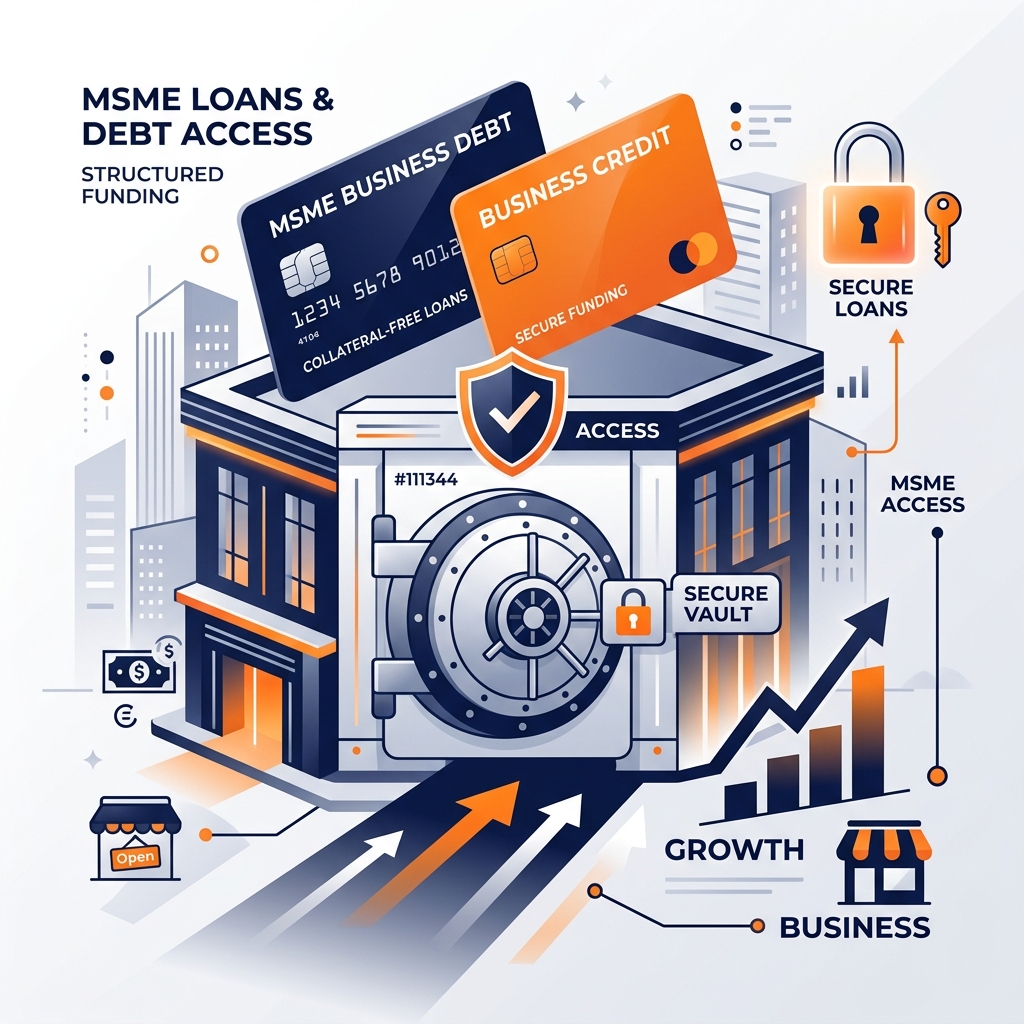
Introduction
India's 63 million MSMEs contribute nearly 30% of the country's GDP and employ over 110 million people. Yet the vast majority of these businesses remain chronically underfunded — not because the money does not exist, but because most MSME owners do not know how to access it in a structured way.
The traditional approach to business funding in India — walking into a bank, asking for a loan, getting rejected due to lack of collateral or credit history, and giving up — is no longer the only path. In 2026, the structured debt landscape for Indian SMEs and MSMEs is broader, more accessible, and more sophisticated than at any point in the country's history.
Structured debt funding refers to a range of formal debt instruments — term loans, working capital facilities, invoice financing, revenue-based financing, venture debt, and government-backed credit guarantees — that are designed to match a business's specific cash flow needs, risk profile, and growth stage.
This guide breaks down every major structured debt instrument available to Indian SMEs and MSMEs in 2026 — who they are for, how to access them, what documentation is required, and how to build a debt funding strategy that strengthens rather than strains your business.
Why Structured Debt Is Often Better Than Equity for SMEs
Before diving into the instruments, it is worth addressing a fundamental question: why should an SME or MSME owner consider debt at all, when equity feels like 'free money'?
The answer is straightforward: equity is not free. It is expensive — permanently.
- When you give an investor 20% equity in your company, you give up 20% of every future rupee of value your business creates — forever, unless you buy them out
- Debt, by contrast, has a fixed cost — the interest rate — and a fixed term. Once repaid, the lender has no further claim on your business
- For businesses with predictable, recurring cash flows — which describes most established SMEs and MSMEs — debt is almost always the capital-efficient choice
- Debt does not dilute your ownership, does not require board seats, and does not come with investor governance expectations
- Well-managed debt improves your credit profile, making future capital access progressively easier and cheaper
The challenge for most Indian SMEs is not that debt is the wrong choice — it is that they have never had access to the full range of debt instruments available, and have never been coached on how to present themselves as creditworthy borrowers.
💡 Key Principle: The goal of structured debt advisory is not to help you borrow as much as possible — it is to help you borrow the right amount, through the right instrument, at the right time, structured in a way your cash flows can comfortably service. Debt that grows a business is an asset. Debt that strains cash flow is a liability.
The Indian Debt Funding Landscape for SMEs in 2026: An Overview
The structured debt ecosystem for Indian SMEs sits across three broad categories:
- Government-backed debt: CGTMSE, PMEGP, SIDBI schemes, Stand-Up India, Mudra loans — subsidised or guaranteed instruments backed by public policy
- Institutional bank debt: Term loans, working capital facilities, overdraft limits, and letters of credit from commercial banks and NBFCs
- Alternative / fintech debt: Revenue-based financing, invoice discounting, supply chain financing, venture debt — newer instruments enabled by financial technology and data-driven credit assessment
Each category serves a different business profile and stage. The smartest MSME funding strategies combine instruments across all three categories — maximising the total credit available while minimising the cost and concentration risk.
Debt Category
Key Instruments
Best For
Ticket Size
Government-backed
CGTMSE, PMEGP, SIDBI, Mudra
Early-stage, collateral-poor MSMEs
₹50K – ₹5 Cr
Bank / NBFC
Term loans, WC limits, OD facility
Established businesses with financials
₹5 L – ₹50 Cr+
Alternative / Fintech
RBF, invoice discounting, venture debt
Revenue-generating startups & SMEs
₹10 L – ₹20 Cr
<w:bottom w:val="single" w:color="1A6E3C" w:sz="12" w:space="4"/><w:left w:val="single" w:color="1A6E3C" w:sz="40" w:space="8"/><w:right w:val="single" w:color="1A6E3C" w:sz="12" w:space="4"/></w:pBdr><w:spacing w:before="200" w:after="180"/><w:ind w:left="360"/></w:pPr><w:r><w:rPr><w:rFonts w:ascii="Arial" w:cs="Arial" w:eastAsia="Arial" w:hAnsi="Arial"/><w:b/><w:bCs/><w:color w:val="1A6E3C"/><w:sz w:val="27"/><w:szCs w:val="27"/></w:rPr><w:t xml:space="preserve">🌱 Instrument 1: Pradhan Mantri Mudra Yojana (PMMY) — India's largest micro-enterprise lending programme
PMMY — commonly known as the Mudra loan scheme — is the entry point of structured debt for micro and small businesses in India. Launched in 2015, it provides collateral-free loans through banks, NBFCs, and microfinance institutions to non-farm income-generating activities.
The Three Mudra Tiers
- Shishu: Loans up to ₹50,000 — for businesses just starting up or with minimal capital needs
- Kishore: Loans from ₹50,001 to ₹5 lakh — for businesses looking to expand operations or purchase equipment
- Tarun: Loans from ₹5 lakh to ₹10 lakh — for established micro-enterprises seeking growth capital
In 2024, the Tarun Plus category was introduced — extending loans up to ₹20 lakh for Tarun borrowers with a good repayment track record.
Who Should Use Mudra Loans
- Street vendors, small retailers, artisans, and service providers at the micro scale
- First-time borrowers with no prior credit history — Mudra is often the credit-building entry point
- Businesses that need small, quick capital for inventory, equipment, or working capital
- Borrowers in rural and semi-urban areas where bank branch access is limited
💡 Pro Tip: Mudra loans are best used as the first rung of the credit ladder. A clean Mudra repayment record significantly improves your credit score and your eligibility for larger CGTMSE-backed term loans at a later stage. Use Mudra to build your credit profile, not just to access capital.
<w:bottom w:val="single" w:color="0D6E6E" w:sz="12" w:space="4"/><w:left w:val="single" w:color="0D6E6E" w:sz="40" w:space="8"/><w:right w:val="single" w:color="0D6E6E" w:sz="12" w:space="4"/></w:pBdr><w:spacing w:before="200" w:after="180"/><w:ind w:left="360"/></w:pPr><w:r><w:rPr><w:rFonts w:ascii="Arial" w:cs="Arial" w:eastAsia="Arial" w:hAnsi="Arial"/><w:b/><w:bCs/><w:color w:val="0D6E6E"/><w:sz w:val="27"/><w:szCs w:val="27"/></w:rPr><w:t xml:space="preserve">🔄 Instrument 2: Working Capital Facilities — Keep the business running without burning equity
Working capital is the lifeblood of every operating business — and one of the most common reasons SMEs stall is not a lack of orders or revenue, but a timing mismatch between when money goes out and when money comes in.
Banks and NBFCs offer several working capital instruments specifically designed for this cash flow timing challenge:
Cash Credit (CC) and Overdraft (OD) Facilities
A Cash Credit or Overdraft facility allows a business to draw funds up to a sanctioned limit based on their stock, debtors, and business turnover. Interest is charged only on the amount actually drawn, not on the full sanctioned limit — making it one of the most cost-efficient working capital instruments available.
- Sanctioned based on: Audited financials, working capital cycle analysis, debtors, and inventory position
- Security: Stock and book debts — no fixed property collateral required in many cases
- Renewal: Typically reviewed and renewed annually based on updated financials
- Best for: Manufacturing businesses, traders, distributors, and service businesses with 30–90 day payment cycles
Bill Discounting and Invoice Financing
For businesses that sell to other businesses (B2B) and issue invoices with 30–90 day payment terms, invoice financing unlocks the value of those outstanding invoices immediately — without waiting for the customer to pay.
- How it works: You submit outstanding invoices to a bank or fintech platform; they advance 80–90% of the invoice value upfront; when your customer pays, the remaining 10–20% is released minus the financing fee
- No collateral required: The invoice itself is the security
- Fast processing: Many fintech platforms like M1xchange, KredX, and Velocity process invoice financing within 24–48 hours
- Best for: B2B businesses with large corporate or government clients who pay on 60–90 day terms
💡 Pro Tip: Invoice financing is particularly powerful for MSMEs that supply to large corporates or PSUs — where payment terms are long but the creditworthiness of the buyer is unquestionable. The buyer's credit profile, not yours, drives the approval.
Purchase Order (PO) Financing
PO financing allows SMEs to access capital against confirmed purchase orders — before the goods are produced or delivered. This solves a critical gap for manufacturers and traders who win large orders but lack the working capital to fulfil them.
- Lender advances funds against the confirmed purchase order from a creditworthy buyer
- Funds are used to purchase raw materials or produce the order
- Repaid from the proceeds when the buyer pays the invoice
- Best for: Manufacturers, exporters, and traders with large institutional or export orders
<w:bottom w:val="single" w:color="1A3C6E" w:sz="12" w:space="4"/><w:left w:val="single" w:color="1A3C6E" w:sz="40" w:space="8"/><w:right w:val="single" w:color="1A3C6E" w:sz="12" w:space="4"/></w:pBdr><w:spacing w:before="200" w:after="180"/><w:ind w:left="360"/></w:pPr><w:r><w:rPr><w:rFonts w:ascii="Arial" w:cs="Arial" w:eastAsia="Arial" w:hAnsi="Arial"/><w:b/><w:bCs/><w:color w:val="1A3C6E"/><w:sz w:val="27"/><w:szCs w:val="27"/></w:rPr><w:t xml:space="preserve">🏗️ Instrument 3: Term Loans for Capex and Expansion — Long-term capital for assets and growth investments
Term loans are the most widely understood debt instrument — a lump sum disbursed for a specific purpose, repaid in EMIs over a defined tenure. For SMEs, term loans are primarily used for capital expenditure (machinery, equipment, infrastructure) and business expansion (new premises, geographic entry, additional capacity).
Secured vs Unsecured Term Loans
Secured term loans are backed by a specific asset — property, machinery, or equipment. They typically offer lower interest rates (8–14% per annum) and higher loan amounts. They are the right instrument when you have an asset to pledge and are making a long-term capital investment that the asset itself will enable.
Unsecured term loans require no collateral but typically carry higher interest rates (14–24% per annum) and lower loan amounts. NBFCs and fintech lenders have made these significantly more accessible in recent years using GST data, bank statement analysis, and alternate credit scoring. They are suitable for service businesses or asset-light SMEs.
SIDBI Term Loans: The Government Alternative
SIDBI's direct lending programs offer term loans to MSMEs at 1–2% below commercial bank rates. The SIDBI SMILE (Make in India Loan for Enterprises) scheme provides soft loans of ₹10 lakh to ₹25 lakh specifically to new and early-stage manufacturing enterprises, with a lower equity contribution requirement and a moratorium period on principal repayment.
- Interest rate: Typically 1–2% below MCLR — significantly below commercial bank rates
- Loan amount: ₹10 lakh to no upper cap for viable projects under direct lending
- SMILE scheme: Designed specifically for new MSME units in manufacturing — quasi-equity structure
- Eligibility: MSME registration (Udyam), basic financial documentation, and a credible business plan
⚠️ Common Mistake: Many SME owners approach banks for term loans without a Detailed Project Report (DPR) that clearly maps the loan amount to a specific asset or expansion purpose. Banks require this mapping — a vague loan request for 'business development' is almost always rejected. Every term loan application must specify exactly what the capital will purchase and how that purchase generates the repayment capacity.
<w:bottom w:val="single" w:color="E8712A" w:sz="12" w:space="4"/><w:left w:val="single" w:color="E8712A" w:sz="40" w:space="8"/><w:right w:val="single" w:color="E8712A" w:sz="12" w:space="4"/></w:pBdr><w:spacing w:before="200" w:after="180"/><w:ind w:left="360"/></w:pPr><w:r><w:rPr><w:rFonts w:ascii="Arial" w:cs="Arial" w:eastAsia="Arial" w:hAnsi="Arial"/><w:b/><w:bCs/><w:color w:val="E8712A"/><w:sz w:val="27"/><w:szCs w:val="27"/></w:rPr><w:t xml:space="preserve">🚀 Instrument 4: Venture Debt — Non-dilutive capital for funded startups and growth-stage SMEs
Venture debt is a relatively newer instrument in India's debt ecosystem — but one that has grown dramatically in the last five years. It is a form of debt financing available specifically to startups and growth-stage companies that have already raised equity funding from venture capital investors.
Unlike traditional bank loans, venture debt lenders do not require profitability or extensive collateral. Instead, they rely on the startup's equity backing, investor pedigree, and growth trajectory to assess creditworthiness.
How Venture Debt Works
Venture debt is typically provided as a term loan of 3–4 years, often with a 6–12 month interest-only period at the beginning (the moratorium), followed by principal and interest repayment. Most venture debt deals also include a small warrant coverage — the right to purchase equity at a predetermined price — as additional compensation to the lender for the higher risk.
- Loan size: Typically 20–35% of the last equity round raised
- Interest rate: 14–20% per annum — higher than bank debt, lower than equity cost
- Warrant coverage: Usually 0.5–2% of the loan amount in equity warrants
- Best used for: Extending runway between equity rounds, funding specific growth initiatives without dilution, or bridging to a known revenue milestone
- Key Indian providers: InnoVen Capital, Trifecta Capital, Alteria Capital, Stride Ventures, and Blacksoil
When Venture Debt Makes Sense for Your Startup
- You have already raised a seed or Series A round from a recognised VC
- You need 6–12 more months of runway than your current equity provides
- You are 12–18 months from a clear revenue milestone that will support the next equity round
- You want to fund a specific, measurable initiative (product launch, geographic expansion, key hire) without diluting further
- Your monthly burn rate is predictable and your path to the next milestone is well-defined
💡 ConsultUp Insight: Venture debt is one of the most underutilised instruments in India's startup funding toolkit. A ₹3 crore equity round extended by ₹75 lakh in venture debt at 16% interest saves founders 4–5% in equity dilution — which at a ₹20 crore Series A valuation is worth ₹80 lakh to ₹1 crore in preserved founder equity. The math is compelling.
<w:bottom w:val="single" w:color="9A6F00" w:sz="12" w:space="4"/><w:left w:val="single" w:color="9A6F00" w:sz="40" w:space="8"/><w:right w:val="single" w:color="9A6F00" w:sz="12" w:space="4"/></w:pBdr><w:spacing w:before="200" w:after="180"/><w:ind w:left="360"/></w:pPr><w:r><w:rPr><w:rFonts w:ascii="Arial" w:cs="Arial" w:eastAsia="Arial" w:hAnsi="Arial"/><w:b/><w:bCs/><w:color w:val="9A6F00"/><w:sz w:val="27"/><w:szCs w:val="27"/></w:rPr><w:t xml:space="preserve">📊 Instrument 5: Revenue-Based Financing (RBF) — Repay as you earn — aligned with your growth rhythm
Revenue-Based Financing is one of the most founder-friendly debt instruments to emerge in India's financial ecosystem in recent years. Unlike traditional loans with fixed EMIs, RBF repayment is tied directly to your monthly revenue — you pay more when revenue is high, and less when it slows down.
How Revenue-Based Financing Works
- The lender advances a lump sum (typically 1–3x your monthly revenue)
- Repayment is structured as a fixed percentage of monthly revenue — typically 5–15%
- Total repayment is a predetermined multiple of the advance — typically 1.2x to 1.5x (the 'revenue cap')
- No equity is given up — no warrants, no dilution, no board seats
- The repayment period varies based on revenue performance — faster growth means faster payoff
Key RBF Providers in India
- Velocity: Focused on D2C and e-commerce brands; advances based on marketplace revenue
- GetVantage: Serves SaaS and subscription businesses; 12–24 month repayment terms
- Recur Club: Focused on SaaS companies; data-driven underwriting using subscription metrics
- N+1 Capital: Broader sector coverage; competes with venture debt for growth-stage companies
- Klub: Serves consumer brands, F&B, and retail businesses with recurring revenue
When RBF Is the Right Choice
- You have recurring, predictable monthly revenue of at least ₹10–15 lakh per month
- You want capital without giving up equity — especially useful before a Series A to avoid bridge round dilution
- Your revenue is seasonal or variable — fixed EMI debt would be stressful; RBF flexes with your cash flow
- You need capital for a specific, revenue-generating initiative — paid marketing, inventory purchase, expansion hiring
- You want a fast decision — most RBF platforms approve and disburse within 5–10 business days
⚠️ Watch Out: RBF is significantly more expensive than bank debt when you calculate the effective annualised rate — a 1.3x revenue cap repaid over 18 months is roughly equivalent to a 20–25% annualised interest rate. It makes sense when speed and flexibility are worth the premium — but should not be used as a substitute for bank debt when the latter is accessible.
<w:bottom w:val="single" w:color="0D6E6E" w:sz="12" w:space="4"/><w:left w:val="single" w:color="0D6E6E" w:sz="40" w:space="8"/><w:right w:val="single" w:color="0D6E6E" w:sz="12" w:space="4"/></w:pBdr><w:spacing w:before="200" w:after="180"/><w:ind w:left="360"/></w:pPr><w:r><w:rPr><w:rFonts w:ascii="Arial" w:cs="Arial" w:eastAsia="Arial" w:hAnsi="Arial"/><w:b/><w:bCs/><w:color w:val="0D6E6E"/><w:sz w:val="27"/><w:szCs w:val="27"/></w:rPr><w:t xml:space="preserve">🔗 Instrument 6: Supply Chain Finance — Unlock cash trapped in your supply chain
Supply chain finance (SCF) covers a suite of instruments designed to optimise the flow of working capital through a business's supplier and buyer relationships. For Indian SMEs that sit in the middle of a supply chain — buying from suppliers and selling to distributors or large corporates — SCF can unlock significant liquidity without adding traditional debt.
Key Supply Chain Finance Instruments
Dealer / Distributor Financing
Large corporates and banks offer financing to the dealers and distributors of a major brand or anchor company. The anchor's credit profile enables dealers to access working capital at rates significantly lower than they could obtain independently.
- How to access: If you are a distributor or dealer for a major brand, ask the anchor company whether they have a dealer financing programme
- Key providers: HDFC Bank, ICICI Bank, Axis Bank, and most major NBFCs have corporate anchor SCF programmes
Vendor Financing (Reverse Factoring)
The reverse of invoice discounting — a large corporate buyer enables its suppliers to access early payment against outstanding invoices. The supplier gets paid early; the corporate pays on the original due date.
- Most useful for: SME suppliers to large corporates and PSUs where payment terms stretch 60–90 days
- Cost: Lower than standalone invoice financing because it is backed by the buyer's (not seller's) credit profile
- Platform: TReDS (Trade Receivables Discounting System) — a government-mandated electronic platform where buyers and sellers connect with financiers for SCF transactions
TReDS: India's Most Underused MSME Financing Platform
The Trade Receivables Discounting System (TReDS) is a government-mandated electronic platform that enables MSMEs to discount their trade receivables (invoices) from corporate buyers through a competitive auction process among registered financiers.
- Government and large corporate buyers are mandated to register on TReDS — ensuring access to creditworthy buyer payables
- Financing rates are determined by competitive bidding among financiers — typically 7–11% annualised, significantly lower than other short-term instruments
- MSME suppliers receive payment within 1–2 business days of invoice acceptance
- The three licensed TReDS platforms in India are: M1xchange (Mynd Solutions), RXIL (NSE-backed), and A.TREDS (Axis Bank)
💡 ConsultUp Insight: TReDS is one of the best-kept secrets in MSME finance. If you are an MSME supplier to any large corporate or PSU, you may be eligible to discount your invoices at 7–9% annualised rates — far cheaper than a bank overdraft or invoice financing platform. The barrier is awareness and onboarding support — both of which we help with.
The Documentation Stack: What Every Debt Application Needs
The single biggest barrier between most Indian SMEs and their first structured debt facility is documentation quality. Banks and NBFCs have clear, predictable documentation requirements — and applications that do not meet them are rejected or delayed, not because the business is undeserving, but because the paperwork is incomplete or inconsistent.
Here is the core documentation stack required for most debt applications:
Business Identity Documents
- MSME / Udyam Registration Certificate
- GST Registration Certificate and GST returns for the last 12–24 months
- Company incorporation certificate (MCA) or Partnership Deed / LLP Agreement
- PAN card of the entity and all directors/partners
- DPIIT recognition certificate (for startups — accelerates processing at many institutions)
Financial Documents
- Audited financial statements for the last 2–3 years (Balance Sheet, P&L, Cash Flow Statement)
- Income Tax Returns (ITR) for the last 2–3 years — filed and acknowledged
- Bank statements for the last 12 months for all business accounts
- GST-filed invoices or sales registers as evidence of turnover
- Debtors and creditors ageing schedule (for working capital applications)
Business Plan and Projections
- Detailed Project Report (DPR) — especially for term loans and government-backed instruments
- 3 to 5-year financial projections with clear assumptions and repayment modelling
- Cash flow projections showing monthly repayment capacity
- Use of funds statement — exactly how the loan amount will be deployed
Collateral and Property Documents (where applicable)
- Property title deeds or lease agreements
- Machinery valuation reports (for equipment loans)
- Stock statements and debtors statements (for working capital facilities)
⚠️ The Consistency Rule: Every number in your financial documents must be reconcilable across all submissions. Your GST returns, ITR, bank statements, and audited accounts must tell the same story about your revenue. Inconsistencies — even minor ones — flag your application for extended scrutiny or rejection. This is the most common preventable reason for MSME loan rejection in India.
Building Your MSME Credit Profile: The Long Game
Access to structured debt is not just about submitting a loan application — it is about building a credit profile over time that makes each successive application easier, faster, and cheaper than the last.
Here is the credit profile-building roadmap that every serious MSME owner should follow:
- Register on Udyam: Udyam registration is the foundational identity for all MSME schemes, bank priority sector lending, and government procurement. Get it before everything else.
- Start with a Mudra or CGTMSE loan: Even if you do not strictly need the capital, a small, well-repaid Mudra loan builds your first credit history on CIBIL and CRIF. This is the first rung of the credit ladder.
- Maintain a clean bank account: Keep all business transactions — sales, expenses, GST payments — through a dedicated business current account. Six months of clean, consistent bank statements is one of the most powerful credit signals.
- File GST returns on time, every time: GST compliance is now a primary credit signal for digital lenders, NBFCs, and many banks. Irregular filing, late returns, or mismatches between GSTR-1 and GSTR-3B raise immediate red flags.
- Build a relationship with your bank: Businesses that maintain their primary current account, salary account, and first loan with the same institution consistently get faster processing and better terms on subsequent facilities.
- Monitor your CIBIL MSE rank: CIBIL provides a dedicated MSME credit ranking system. Know your score, understand what affects it, and take deliberate steps to improve it before every major loan application.
- Separate personal and business finances completely: Mixed accounts, personal expenses charged to business accounts, and undocumented director loans are red flags in every bank credit assessment. Keep them strictly separate.
💡 ConsultUp Insight: The MSMEs that access the largest credit facilities at the lowest rates are not necessarily the most profitable businesses — they are the businesses with the cleanest, most consistent, best-documented financial history. Financial discipline is a lending superpower. Build it from day one.
Quick Comparison: All Debt Instruments at a Glance
Instrument
Best For
Ticket Size
Collateral?
Speed
Mudra Loan
Micro businesses, first credit
Up to ₹20L
No
1–3 weeks
Working Capital (CC/OD)
Operating businesses, cash gaps
₹5L – ₹5Cr
Stock/debtors
2–4 weeks
Invoice Financing
B2B businesses with long cycles
₹1L – ₹5Cr
No
24–72 hours
Term Loan (Bank)
Capex, expansion, assets
₹10L – ₹50Cr+
Usually yes
3–6 weeks
SIDBI Loans
Manufacturing MSMEs
₹10L – No cap
Partial
4–8 weeks
CGTMSE
Any MSME, no collateral
Up to ₹5Cr
No
3–6 weeks
Venture Debt
VC-backed startups
₹50L – ₹20Cr
No
2–4 weeks
Revenue-Based (RBF)
Recurring revenue businesses
₹10L – ₹5Cr
No
1–2 weeks
TReDS / Invoice Disc.
MSME suppliers to large buyers
Per invoice
No
1–2 days
PO Financing
Manufacturers/traders with orders
₹5L – ₹10Cr
PO as security
1–3 weeks
6 Structured Debt Mistakes Indian SMEs Make — and How to Avoid Them
Mistake 1: Applying to Multiple Banks Simultaneously Without Strategy
Every bank loan application triggers a hard credit inquiry on your CIBIL report. Multiple simultaneous applications cause multiple hard inquiries, which temporarily lower your credit score and signal desperation to each lender. Apply to one institution at a time, with a full, well-prepared application package.
Mistake 2: Under-Borrowing Out of Caution
Many SME owners borrow less than they need because they are nervous about repayment. This leads to capital shortfall mid-project — which often requires an emergency top-up at worse terms. Borrow the right amount from the start, based on a realistic project plan — not the minimum you think you can get by with.
Mistake 3: Mixing Instruments with Mismatched Tenures
Using a short-term working capital facility to fund long-term capital expenditure is one of the most common MSME financial mistakes. Working capital lines need to be repaid within months; capex generates returns over years. Matching the tenure of the debt to the duration of the asset it funds is a fundamental principle of structured debt.
Mistake 4: Poor Financial Record-Keeping
Informal bookkeeping, cash transactions not reflected in bank accounts, and unaudited financials are the fastest way to be declined for any formal debt facility. Even if your business is genuinely profitable, informal records make it impossible to prove — and impossible to lend against.
Mistake 5: Ignoring Government-Backed Instruments
The majority of Indian SMEs that qualify for CGTMSE, SIDBI schemes, or TReDS financing never apply — either because they are unaware or because they assume the process is too complex. Government-backed instruments are almost always the cheapest debt available. They should be exhausted before turning to commercial alternatives.
Mistake 6: No Repayment Modelling Before Borrowing
Taking on debt without modelling the monthly EMI against your projected cash flows is a recipe for stress. Before every debt application, build a simple cash flow model that shows your monthly revenue, operating expenses, existing debt obligations, and the new EMI — and confirm your business can service the debt comfortably across your base, bull, and bear scenarios.
How ConsultUp India Helps SMEs and MSMEs Access Structured Debt
At ConsultUp India, our structured debt advisory service is built around one principle: getting the right capital for your business, structured the right way, from the right source, at the right time.
We work with SMEs and MSMEs at every stage of their debt journey:
- Debt readiness assessment: Reviewing your current financial documentation, credit profile, and business model to identify gaps before you apply
- Instrument mapping: Identifying which debt instruments — government-backed, bank, or alternative — are most appropriate for your specific need and profile
- Documentation preparation: Building the complete application package — DPR, financial projections, cash flow models, use-of-funds statements, and all compliance documentation
- Bank liaison: Helping you present your application to the right branch manager or relationship manager and responding to queries throughout the assessment process
- Debt stack design: For growth-stage SMEs, designing a layered debt structure that combines government-backed, bank, and alternative instruments to maximise total credit at minimum cost
- Ongoing advisory: Supporting you through the annual renewal of working capital facilities and preparing for larger term loan applications as your business grows
<w:bottom w:val="single" w:color="1A3C6E" w:sz="6" w:space="4"/><w:left w:val="single" w:color="1A3C6E" w:sz="6" w:space="4"/><w:right w:val="single" w:color="1A3C6E" w:sz="6" w:space="4"/></w:pBdr><w:spacing w:before="160" w:after="160"/><w:jc w:val="center"/></w:pPr><w:r><w:rPr><w:rFonts w:ascii="Arial" w:cs="Arial" w:eastAsia="Arial" w:hAnsi="Arial"/><w:b/><w:bCs/><w:sz w:val="22"/><w:szCs w:val="22"/></w:rPr><w:t xml:space="preserve">🏦 Ready to build your MSME debt funding strategy? Visit consultupindia.com or call 1800-202-1945 for a free debt readiness consultation.
Final Thoughts
Structured debt is not a last resort when equity is unavailable. For most Indian SMEs and MSMEs, it is the primary, most capital-efficient funding tool available — and one that the most successful business owners have mastered over decades of growth.
The landscape has never been richer. From government-backed Mudra loans and CGTMSE guarantees to sophisticated invoice discounting platforms and venture debt providers, Indian SMEs in 2026 have access to a structured debt ecosystem that rivals any market in the world.
The only thing standing between most MSME owners and this capital is awareness, documentation quality, and the right advisory support to navigate a complex but genuinely accessible system.
Build your credit profile deliberately. Match your instruments to your needs. And never borrow more — or less — than your business can intelligently deploy and comfortably repay.
Tags: MSME debt funding India 2026, SME structured debt, CGTMSE loan MSME, SIDBI MSME loan, venture debt India, revenue based financing India, invoice discounting MSME, TReDS platform India, working capital loan SME, Mudra loan India, ConsultUp India debt advisory
© 2026 ConsultUp India (CISPL Conzultupindia Services Private Limited) | consultupindia.com
Ready to become funding-ready?
Book a free consultation and we’ll map your funding roadmap — grants, investors, and compliance in one plan.
Book a call# Keep reading

How to Create an Investor-Ready Pitch Deck for Early-Stage Startups in India (2026 Guide)
You have a great idea. Maybe even a proof of concept. But every time you walk into an investor meeting — or fill out a grant application — you feel like something…
10 Slides Every Startup Pitch Deck Must Have to Impress Indian Investors
You have an idea that could change an industry. Your product works. Your team is committed. But the moment you walk into an investor meeting in India, none of that…