
PMEGP, CGTMSE, SIDBI & Stand-Up India: Which Government Loan Scheme Is Right for Your Startup?
Introduction
Every Indian startup founder knows about the search for funding. But most think about it in terms of investors, pitch decks, and equity rounds. What far fewer founders realise is that some of the most accessible, founder-friendly capital in India does not come from investors at all — it comes from the government.
India has built one of the most comprehensive government-backed loan and subsidy ecosystems in Asia, specifically designed to put capital into the hands of first-generation entrepreneurs, MSMEs, and early-stage startups. The four flagship schemes — PMEGP, CGTMSE, SIDBI, and Stand-Up India — collectively disburse thousands of crores every year to businesses that most venture capitalists would never fund.
The challenge is not access. It is awareness and application quality.
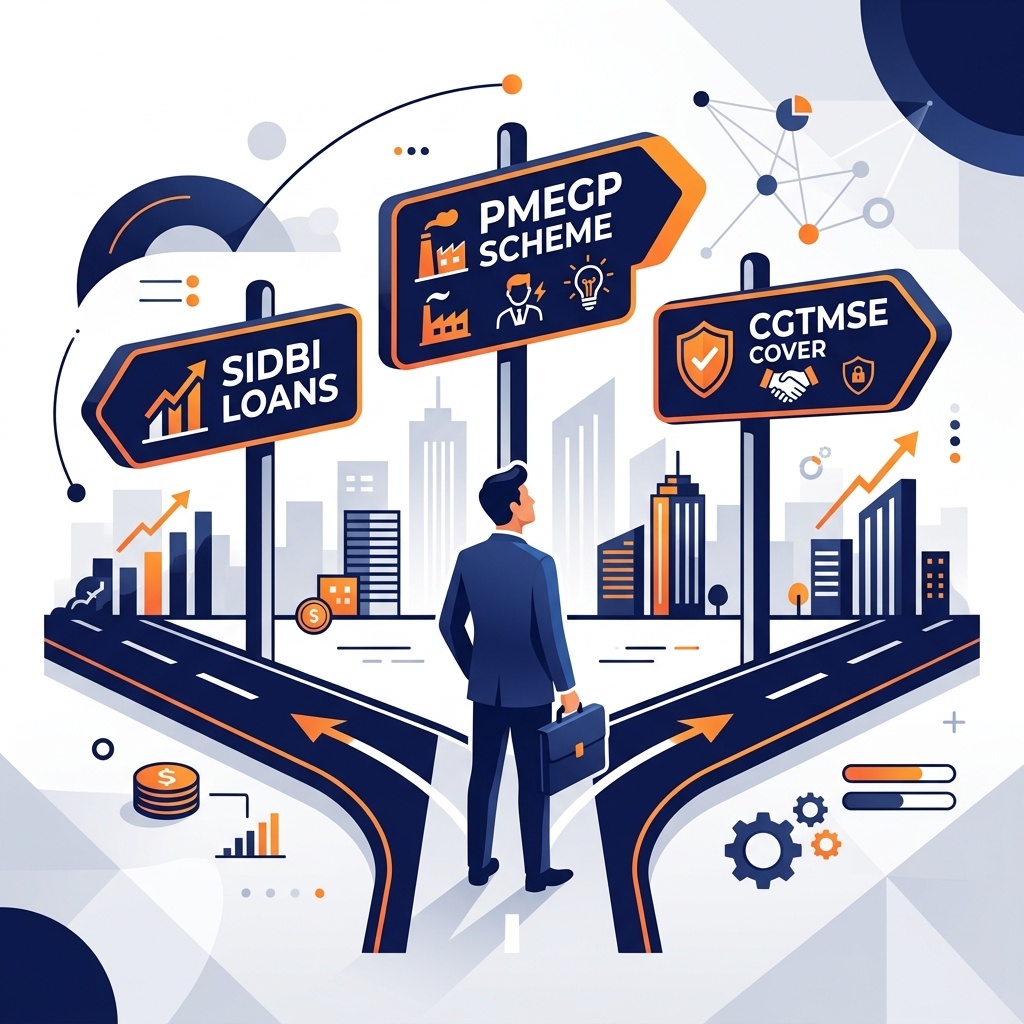
In this guide, we break down each of the four major government loan schemes — what they offer, who they are for, how they differ, and how to decide which one (or which combination) is right for your startup. We also include a side-by-side comparison table and a decision framework to help you choose without confusion.
Why These Four Schemes Matter for Indian Startups and MSMEs
Before diving into the details, here is the big picture: these four schemes serve different purposes and different founder profiles. None of them are interchangeable — and using the wrong one wastes both time and money.
- PMEGP (Prime Minister's Employment Generation Programme) is a subsidy-linked loan scheme for new micro-enterprises, especially in manufacturing and services.
- CGTMSE (Credit Guarantee Fund Trust for Micro and Small Enterprises) is not a loan itself — it is a guarantee mechanism that enables banks to lend to MSMEs without requiring collateral.
- SIDBI (Small Industries Development Bank of India) operates multiple direct and indirect funding programs targeting startups, MSMEs, and innovation-led companies.
- Stand-Up India is a targeted scheme that reserves formal bank credit for SC/ST entrepreneurs and women founders setting up greenfield enterprises.
Together, these four schemes represent a funding infrastructure that most early-stage Indian founders are sitting on top of — without even knowing it.
Scheme 1: PMEGP — Prime Minister's Employment Generation Programme
PMEGP is one of India's most widely used government schemes for micro-enterprise creation. Launched in 2008 by merging two earlier schemes (PMRY and REGP), it is administered by the Khadi and Village Industries Commission (KVIC) and implemented through District Industries Centres (DICs), KVIB, and commercial banks.
Its core proposition is simple: the government subsidises a portion of your project cost upfront, the bank lends you the rest, and you contribute a small margin — giving you capital to start a business without needing any prior credit history or collateral.
Administered by
KVIC, KVIB, and District Industries Centres (DICs)
Loan amount
Up to ₹50 lakh (manufacturing); up to ₹20 lakh (services)
Subsidy (urban)
15% of project cost for general category founders
Subsidy (rural/SC/ST/Women/Ex-servicemen)
25–35% of project cost
Beneficiary contribution
5–10% of project cost (founder's own margin money)
Bank loan
Remaining project cost funded by partner bank
Collateral
Not required for loans up to ₹10 lakh
Repayment
3 to 7 years depending on loan size
Who can apply
Indian citizens 18+; 8th Standard pass for projects above ₹10 lakh; new enterprises only
How to apply
Online via the KVIC portal (kviconline.gov.in)
What Makes PMEGP Unique
The key differentiator is the upfront margin money subsidy — the government essentially gives you a non-repayable grant that reduces the total loan amount. For a ₹20 lakh project, a 25% subsidy means ₹5 lakh you never have to pay back. That is equity-free, debt-free capital built directly into the loan structure.
PMEGP is also sector-agnostic — it covers manufacturing, agro-based industries, food processing, textiles, retail services, IT services, and more. This makes it one of the broadest schemes in terms of applicability.
Who Should Apply for PMEGP
- First-generation entrepreneurs starting a new micro-business
- Rural or semi-urban founders — higher subsidy rates apply
- Women founders, SC/ST entrepreneurs, and ex-servicemen — maximum subsidy category
- Founders without assets or credit history who cannot access conventional bank loans
- Businesses in manufacturing, food processing, khadi, textiles, agri-based industries
Common PMEGP Pitfalls to Avoid
- Applying for an existing or already-operational business — PMEGP is strictly for new enterprises
- Submitting a generic Detailed Project Report (DPR) — DPR quality is the single biggest determinant of approval
- Incorrectly selecting the project category — manufacturing vs services have different loan ceilings
- Not accounting for the mandatory EDP (Entrepreneurship Development Programme) training requirement
💡 ConsultUp Tip: The PMEGP Detailed Project Report (DPR) must demonstrate financial viability, employment generation, and repayment capacity. Most rejections happen because the DPR is either too generic or the financial projections are not realistic. A professionally drafted DPR tailored to KVIC evaluation criteria is essential — not optional.
Scheme 2: CGTMSE — Credit Guarantee Fund Trust for Micro and Small Enterprises
CGTMSE is frequently misunderstood — and that misunderstanding costs startups significant loan access. It is not a scheme that gives you money. It is a scheme that removes the biggest barrier to getting a bank loan: the collateral requirement.
When a bank lends under CGTMSE, the Trust guarantees a portion of the loan (75–85%) to the bank. If the borrower defaults, the Trust pays the bank. This means the bank bears far less risk — and is therefore significantly more willing to lend to startups and MSMEs that have no assets to pledge.
Administered by
Ministry of MSME and SIDBI jointly
Type of support
Credit guarantee — not a direct loan
Maximum loan covered
Up to ₹5 crore (enhanced from ₹2 crore in recent years)
Guarantee coverage
75% for general; 80% for micro enterprises; 85% for women/NER/SC-ST/physically challenged
Interest rate
Market rate as per bank's MCLR — no concessional rate, but guarantee enables access
Collateral required
None — that is the entire point of this scheme
Tenure
Up to 5 years for working capital; up to 10 years for term loans
Who applies
You apply to the bank; the bank decides to apply to CGTMSE for the guarantee
Annual guarantee fee
0.37% to 1.35% of outstanding loan amount per year (paid by borrower)
Eligible entities
New and existing Micro and Small Enterprises (not Medium or Large)
How CGTMSE Actually Works in Practice
Many founders are confused about the process because there is no CGTMSE application portal for borrowers. Here is how it works:
- You approach a CGTMSE member lending institution (most nationalised banks, SBI, SIDBI, NBFCs, etc.)
- You present your business plan and loan application to the bank
- The bank evaluates your application and, if approved, applies to CGTMSE for a credit guarantee
- CGTMSE reviews the guarantee application and approves it
- The bank disburses your loan — without requiring any collateral from you
⚠️ Important: The bank still evaluates your business plan, credit history, and financial projections rigorously. CGTMSE does not make the bank ignore creditworthiness — it removes the collateral barrier, not the due diligence barrier. Strong financials and a credible business plan are still essential.
Who Should Use CGTMSE
- Startups and MSMEs that have a strong business plan but no property or assets to pledge as collateral
- Service-sector businesses where physical assets are minimal
- Tech startups, consulting firms, digital agencies — typically asset-light models
- Founders looking for working capital or equipment loans without mortgaging personal property
- Businesses that already have a PMEGP loan and need a top-up credit line
CGTMSE + PMEGP: A Powerful Combination
One of the most effective strategies for early-stage founders is to combine PMEGP and CGTMSE. PMEGP provides the initial project loan with an upfront subsidy. CGTMSE then enables additional working capital credit without collateral as the business grows. Many ConsultUp India clients have used this stack to build a ₹50–80 lakh funding base without any equity dilution or asset pledging.
Scheme 3: SIDBI — Small Industries Development Bank of India
SIDBI is not a single scheme — it is an entire development finance institution with multiple programs designed for different stages and needs of MSMEs and startups. As the principal financial institution for the promotion, financing, and development of the MSME sector in India, SIDBI operates both direct lending programs and indirect programs through other financial intermediaries.
For startups specifically, the most relevant SIDBI touchpoints are:
Institution type
Development Finance Institution under Ministry of MSME
SIDBI Direct Loans
Term loans and working capital for MSMEs — minimum ₹10 lakh, no upper cap for viable projects
SIDBI Startup Fund
Equity and quasi-equity support for early-stage tech and innovation startups
Fund of Funds (FFS)
SIDBI invests in SEBI-registered AIFs/VC funds that invest in startups
SMILE Scheme
Soft loan (quasi-equity) for new and existing MSMEs — lower equity component
SPEED+ Scheme
Collateral-free loans up to ₹25 lakh for micro enterprises
Interest rates
Generally 1–2% below commercial bank rates for direct lending
DPIIT requirement
Preferred for startup-focused programs; mandatory for Fund of Funds access
How to access FFS
Apply through SEBI-registered VC/AIF funds backed by SIDBI — not directly
Best suited for
Tech startups, manufacturing MSMEs, women-led enterprises, and high-growth businesses
SIDBI Fund of Funds: The Startup Angle
For DPIIT-recognised startups that are fundraising-ready, the SIDBI Fund of Funds (FFS) is particularly valuable. SIDBI allocates capital to SEBI-registered VC and AIF funds, which then invest in startups at seed and early stage. By investing in funds rather than directly in startups, SIDBI creates a multiplier effect — its capital enables VCs to take more risk on early-stage companies.
More than 100 VC and AIF funds have received SIDBI FFS allocation. If you are pitching to any of these funds, SIDBI backing strengthens the fund's LP base and often accelerates their investment decision timelines.
SIDBI SMILE: Quasi-Equity for Growth
The SIDBI SMILE (SIDBI Make in India Loan for Enterprises) scheme provides quasi-equity — a soft loan with features of both debt and equity — to new MSMEs with minimum promoter contribution. It is particularly useful for startups in the manufacturing or technology sector that need growth capital but are not yet ready for full equity dilution.
Who Should Explore SIDBI
- Startups and MSMEs with 1–3 years of operational history and financial statements
- Technology-driven startups raising a seed or pre-Series A round via SIDBI-backed VC funds
- Manufacturing and export-oriented MSMEs needing term loans at below-market rates
- Women-led enterprises — SIDBI has specific programs with enhanced terms for women promoters
- Startups that already have DPIIT recognition and are building an institutional fundraising track record
💡 ConsultUp Tip: Accessing SIDBI directly requires strong financial documentation — audited statements, banking history, and a detailed business plan with projections. If you are not yet at that stage, start with CGTMSE or PMEGP to build your credit profile, then approach SIDBI as a second-phase financing option.
Scheme 4: Stand-Up India
Stand-Up India is one of the most powerful and underutilised schemes in India's startup ecosystem — precisely because it targets the most underrepresented groups of founders: Scheduled Caste (SC), Scheduled Tribe (ST) entrepreneurs, and women entrepreneurs.
Launched in 2016, the scheme is administered by the Department of Financial Services under the Ministry of Finance. Its core mandate is to ensure that at least one SC/ST borrower and one woman borrower receives a bank loan from each bank branch in the country — creating a structural commitment to inclusive entrepreneurship at the national level.
Administered by
Department of Financial Services, Ministry of Finance
Loan range
₹10 lakh to ₹1 crore per eligible applicant
Who qualifies
SC/ST entrepreneurs OR women entrepreneurs (18 years+) — for greenfield enterprises only
Project coverage
Up to 85% of the total project cost (15% must be margin money from borrower)
Interest rate
Base rate + 3% + tenor premium — typically 8–11% per annum
Repayment period
Up to 7 years with an 18-month moratorium on principal repayment
Collateral
Covered under CGTMSE — no separate collateral required
Working capital
Rupay debit card facility for operational expenses
Handholding support
Through SIDBI and NABARD — pre-loan and post-loan mentoring available
How to apply
standupmitra.in portal — one application, routed to local bank branches
Why Stand-Up India Is Special
Unlike other schemes where the bank has discretion over who to prioritise, Stand-Up India creates a bank-level obligation. Every bank branch in India is mandated to sanction at least two loans under this scheme — one for an SC/ST founder and one for a woman founder. This means there is dedicated credit reserved specifically for you if you qualify.
The scheme also provides the most generous moratorium period of any major government loan — 18 months before principal repayment begins. For a startup, this is 18 months to generate revenue before the loan repayment burden kicks in.
Who Should Apply for Stand-Up India
- Women founders starting their first formal enterprise — regardless of sector
- SC/ST entrepreneurs who have faced historic barriers to accessing formal bank credit
- Founders setting up a genuinely new business — not expanding an existing one
- Those who want the combination of formal bank credit, CGTMSE coverage, and SIDBI/NABARD mentoring in one package
- First-generation business owners who may not qualify for conventional business loans due to lack of credit history
⚠️ Common Misconception: Stand-Up India is sometimes assumed to be only for traditional or manufacturing businesses. This is incorrect. The scheme applies to manufacturing, services, and trading sectors equally. A woman-founded tech startup or a SC/ST entrepreneur running a digital services business qualifies just as much as a factory owner.
Side-by-Side Comparison: Which Scheme Is Right for You?
Use this comparison to shortlist the scheme(s) most relevant to your profile and stage:
Factor
PMEGP
CGTMSE
SIDBI
Stand-Up India
Type of support
Subsidy + Loan
Loan Guarantee
Direct Loan / FoF
Bank Loan
Funding range
Up to ₹50L
Up to ₹5 Cr
₹10L to No cap
₹10L to ₹1 Cr
Collateral needed
No (up to ₹10L)
No (that's the point)
Depends on program
No (CGTMSE covered)
Who is it for
Micro entrepreneurs
All MSMEs / Startups
MSMEs / Tech Startups
SC/ST / Women only
Best stage
Idea / New business
Any operational stage
Early to Growth
New greenfield only
Is DPIIT required
No
No
Preferred for FFS
No
Subsidy available
Yes — 15 to 35%
No
Concessional rate only
No
Repayment period
3–7 years
Up to 10 years
Varies by program
7 years + 18M moratorium
Apply via
KVIC portal
Through member banks
SIDBI / FFS via VC
standupmitra.in
Can be combined with
CGTMSE
PMEGP, SIDBI, Stand-Up
CGTMSE, FFS
CGTMSE, SIDBI
Decision Framework: How to Choose the Right Scheme
Rather than applying to every scheme and hoping something sticks, use this structured decision framework to identify your best path:
Start Here: What Is Your Founder Profile?
- If you are a woman founder or SC/ST entrepreneur starting a new business — Stand-Up India should be your first conversation with your bank. The dedicated mandate means you have reserved credit waiting for you.
- If you are a first-generation micro-entrepreneur with a new enterprise in manufacturing or services — PMEGP is your primary vehicle. The subsidy component gives you non-repayable capital built into the loan.
- If you are a startup or MSME founder with a strong business plan but no assets to pledge — use CGTMSE as your enabler. Approach any member bank with your plan and ask them to process your loan application under CGTMSE.
- If you are a DPIIT-recognised tech startup already fundraising from VCs — explore SIDBI's Fund of Funds by identifying which SIDBI-backed funds are active in your sector.
Second Question: What Stage Are You At?
- Pre-revenue, idea stage, no incorporation yet: Get incorporated and DPIIT-recognised first. Then apply for PMEGP or Stand-Up India.
- Incorporated, pre-revenue, with a business plan: PMEGP (if new micro-enterprise) or CGTMSE-backed bank loan.
- Early traction, 6–18 months operational: CGTMSE-backed loan for working capital or equipment. Explore SIDBI SPEED+ or SMILE schemes.
- Growth stage, 2+ years, financial statements available: SIDBI direct lending. Also look at CGTMSE for larger credit lines.
Third Question: Can You Combine Schemes?
Yes — and you should. The most effective government funding stacks we see at ConsultUp India include:
- PMEGP subsidy loan + CGTMSE working capital line: Covers initial capex and ongoing operations without any collateral
- Stand-Up India loan + SIDBI NABARD mentoring: Structured credit plus capacity building for women or SC/ST founders
- DPIIT recognition + SISFS grant + CGTMSE loan: The full non-dilutive funding stack for tech startups
💡 ConsultUp Insight: The founders who raise the most non-dilutive capital are not the ones who find the biggest single scheme — they are the ones who stack multiple complementary schemes intelligently. We have helped clients build ₹75 lakh to ₹1.5 crore in government-backed funding across 3–4 stacked instruments, without giving up a single share of equity.
5 Things That Make or Break a Government Loan Application
Across hundreds of scheme applications, we have identified the factors that most consistently determine success or failure:
1. The Quality of Your Detailed Project Report (DPR)
For PMEGP especially, the DPR is everything. It must include market analysis, operational plan, cost structures, revenue projections, employment generation potential, and repayment schedule. A generic template will not pass. A custom, credible DPR significantly improves approval rates.
2. Financial Projections That Demonstrate Repayment Capacity
Banks and scheme evaluators are not just looking for a promising business — they are looking for a business that can repay the loan. Your financial projections must include a cash flow analysis that clearly shows monthly repayment capacity from Year 1 onwards.
3. Consistency Across All Documents
Your business name, address, founder details, and registration numbers must be exactly consistent across your incorporation certificate, PAN, bank statements, scheme application, and DPR. Any inconsistency triggers rejection or extended scrutiny.
4. Banking Relationship Management
For CGTMSE and Stand-Up India especially, the bank relationship manager plays a significant role. Approaching a branch where you have an existing account — even a savings account — is always better than cold-approaching a new branch. Internal familiarity reduces processing friction.
5. Following Up at Every Stage
Government and bank processing timelines are long. A PMEGP application can take 45 to 90 days from submission to disbursement. Applicants who follow up proactively — at the DIC, the bank branch, and the scheme office — consistently see faster processing than those who wait passively.
How ConsultUp India Helps You Navigate Government Loan Schemes
At ConsultUp India, we have guided startups and MSMEs across India through the complete government loan application process — from scheme selection and documentation to DPR preparation and follow-up until disbursement.
Our structured debt advisory service includes:
- Scheme eligibility mapping: Identifying which of the four schemes (or combination) is right for your specific stage, sector, and founder profile
- Detailed Project Report (DPR) preparation: Custom-built, evaluator-ready DPRs for PMEGP and other scheme applications
- Financial projections: Structured cash flow models that demonstrate clear repayment capacity
- Document preparation and consistency review: Ensuring all documents are aligned across the application package
- Bank liaison and follow-up support: Active coordination with branch managers and scheme offices
- CGTMSE application support: Preparing the bank-facing documentation that enables CGTMSE coverage
We have helped founders access their first ₹10 lakh through a PMEGP application and helped growth-stage MSMEs unlock ₹2–5 crore in CGTMSE-backed credit — with the same structured approach.
<w:bottom w:val="single" w:color="1A3C6E" w:sz="6" w:space="4"/><w:left w:val="single" w:color="1A3C6E" w:sz="6" w:space="4"/><w:right w:val="single" w:color="1A3C6E" w:sz="6" w:space="4"/></w:pBdr><w:spacing w:before="160" w:after="160"/><w:jc w:val="center"/></w:pPr><w:r><w:rPr><w:rFonts w:ascii="Arial" w:cs="Arial" w:eastAsia="Arial" w:hAnsi="Arial"/><w:b/><w:bCs/><w:sz w:val="22"/><w:szCs w:val="22"/></w:rPr><w:t xml:space="preserve">🏦 Not sure which scheme is right for you? Visit consultupindia.com or call 1800-202-1945 for a free scheme eligibility assessment.
Final Thoughts
PMEGP, CGTMSE, SIDBI, and Stand-Up India are not competing schemes — they are complementary instruments that serve different founder profiles, business stages, and funding needs. The smartest approach is not to pick one and ignore the rest, but to understand the full landscape and stack the instruments that genuinely fit your situation.
The founders who build strong, sustainable businesses in India are increasingly the ones who know how to use every tool available — including the powerful, non-dilutive government funding infrastructure that most founders leave untouched.
You have already done the hard part: you have a business idea worth building. Now make sure you are accessing every rupee of support the government has made available to help you build it.
Tags: PMEGP scheme 2026, CGTMSE collateral-free loan, SIDBI startup loan India, Stand Up India scheme women SC ST, government loan scheme startup India, MSME loan without collateral, KVIC PMEGP application, ConsultUp India loan advisory
© 2026 ConsultUp India (CISPL Conzultupindia Services Private Limited) | consultupindia.com
Ready to become funding-ready?
Book a free consultation and we’ll map your funding roadmap — grants, investors, and compliance in one plan.
Book a call# Keep reading

How to Create an Investor-Ready Pitch Deck for Early-Stage Startups in India (2026 Guide)
You have a great idea. Maybe even a proof of concept. But every time you walk into an investor meeting — or fill out a grant application — you feel like something…
10 Slides Every Startup Pitch Deck Must Have to Impress Indian Investors
You have an idea that could change an industry. Your product works. Your team is committed. But the moment you walk into an investor meeting in India, none of that…