
Top 10 Government Grants & Schemes for Startups in India in 2026 (DPIIT, Startup India & More)
Introduction
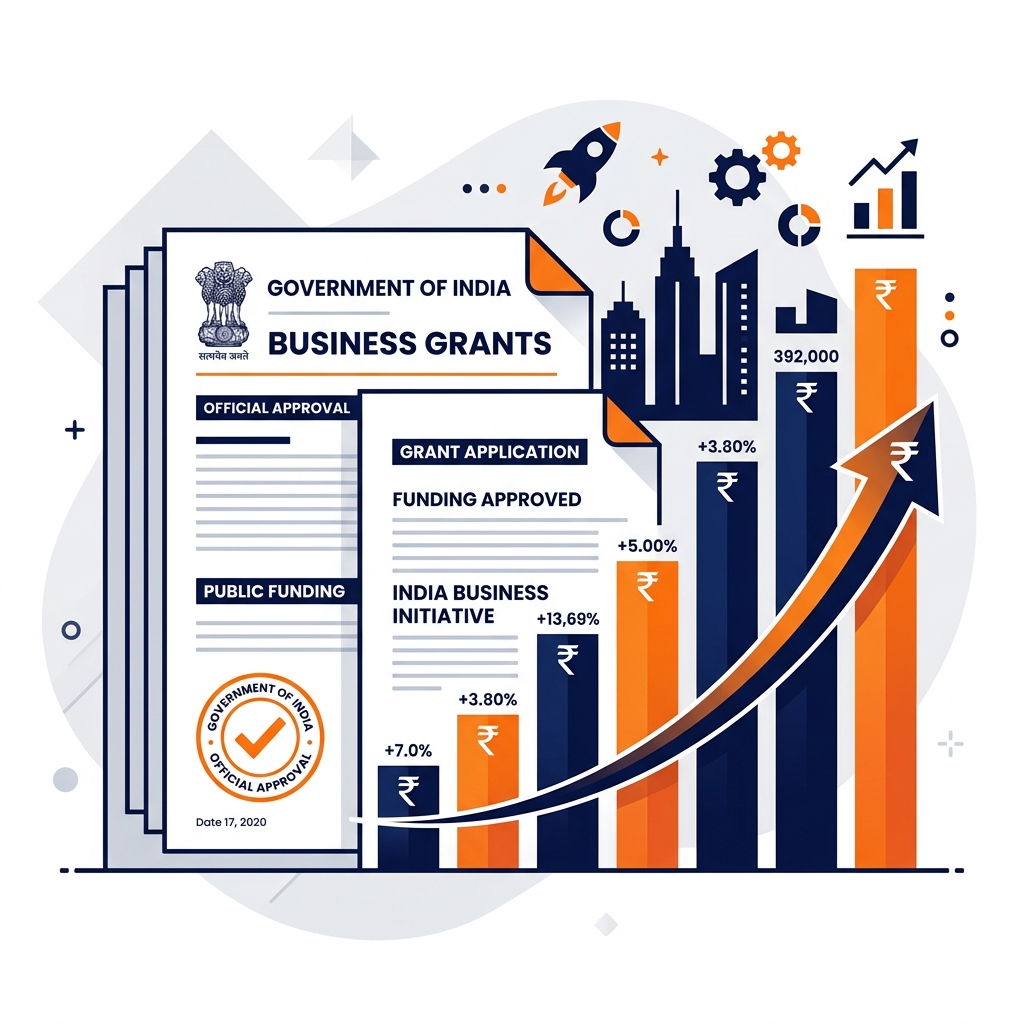
One of the most underutilised funding sources for Indian startups is right in front of them — the Government of India.
Every year, thousands of crores in grants, subsidised loans, equity-free funding, and tax benefits go unclaimed — simply because founders either do not know these schemes exist, do not know how to apply, or submit incomplete applications that get rejected at the first stage.
In 2026, India's startup funding ecosystem is more robust than ever. Between central government schemes, DPIIT-linked programs, state-level initiatives, and sector-specific funds, an early-stage startup with a compelling idea and the right documentation can access anywhere from ₹5 lakh to ₹5 crore in non-dilutive funding — without giving up a single share of equity.
In this guide, we break down the top 10 government grants and schemes Indian startups should know about in 2026 — who they are for, how much they offer, and what it takes to qualify.
Why Government Funding Is Smarter Than You Think
Many founders dismiss government grants as slow, bureaucratic, or too competitive. That is a costly assumption.
Here is why government funding deserves serious attention, especially at the early stage:
- Non-dilutive: You keep 100% of your equity — no investor gets a share of your company
- Credibility signal: A government grant is a powerful third-party validation that opens doors with private investors
- Lower barrier: Many schemes are specifically designed for idea-stage or POC-stage startups with minimal traction
- Accessible across sectors: From agri-tech to fintech, deep tech to social enterprises — there is a scheme for almost every domain
- Stackable: Many startups apply to and receive multiple grants simultaneously — from both central and state programs
💡 Key Insight: At ConsultUp India, we have seen startups successfully raise their first ₹25–50 lakh entirely through government schemes — before approaching a single private investor. That early capital, combined with the credibility it signals, significantly improves their odds of closing a private round.
Quick Reference: Top 10 Schemes at a Glance
Scheme
Funding Type
Amount (Approx.)
Stage
Startup India Seed Fund (SISFS)
Grant + Soft Loan
Up to ₹50 Lakh
Idea / POC / MVP
DPIIT Recognition
Benefits & Tax Exemptions
Non-monetary
All Stages
Atal Innovation Mission (AIM)
Grant
Up to ₹1 Crore
Idea / Innovation
PMEGP
Subsidy + Loan
Up to ₹50 Lakh
Micro Enterprises
CGTMSE
Collateral-free Loan
Up to ₹5 Crore
MSME / Startups
SIDBI Fund of Funds
Equity (via VC)
Variable
Early to Growth
Stand-Up India
Bank Loan
₹10 L – ₹1 Cr
SC/ST/Women Founders
TIDE 2.0 (MeitY)
Grant
Up to ₹1.5 Crore
Tech / ICT Startups
NIF Student Startup
Grant + Mentoring
Up to ₹10 Lakh
Student Founders
State-Level Incubation Grants
Grant
Varies by state
Early Stage
The Top 10 Government Schemes Explained
🚀 Scheme 1: Startup India Seed Fund Scheme (SISFS)
Ministry / Body: Department for Promotion of Industry and Internal Trade (DPIIT)
Funding Available: Up to ₹20 lakh as grant for validation; up to ₹50 lakh as soft loan for prototype or commercialisation
Who Can Apply: DPIIT-recognised startups incorporated for less than 2 years, not previously received more than ₹10 lakh in funding
What You Get:
- Non-dilutive grant funding for proof of concept, prototype development, or product trials
- Soft loan at below-market interest rates for early market entry and commercialisation
- Access to a network of government-empanelled incubators across India
- Mentorship and capacity-building support through the incubator
- Potential follow-on grant of up to ₹50 lakh for market entry
💡 ConsultUp Tip: SISFS applications are evaluated by empanelled incubators — not directly by the government. Your pitch deck, financial projections, and business plan must be tailored specifically to the incubator's evaluation guidelines, not just generic investor materials. This is where most applications fail.
🏛️ Scheme 2: DPIIT Startup Recognition
Ministry / Body: Department for Promotion of Industry and Internal Trade (DPIIT), Ministry of Commerce
Funding Available: Non-monetary — but unlocks access to multiple financial benefits, tax exemptions, and scheme eligibility
Who Can Apply: Any entity incorporated as a private limited company, LLP, or registered partnership — less than 10 years old, annual turnover under ₹100 Cr, working towards innovation or improvement of products/processes/services
What You Get:
- Income Tax exemption under Section 80-IAC for 3 consecutive years out of 10
- Angel Tax exemption under Section 56(2)(viib) on investments received
- Eligibility gateway for SISFS, Atal Innovation Mission, and state-level startup schemes
- Fast-track patent examination at 80% reduced fee
- Access to government procurement portals and tenders without turnover credentials
- Self-certification for 9 labour laws and 3 environmental laws
💡 ConsultUp Tip: DPIIT recognition is not optional for a serious startup — it is the foundation. Almost every central and state government scheme requires it as a prerequisite. If you have not registered yet, it is the first thing to do — and it is free.
💡 Scheme 3: Atal Innovation Mission (AIM) — Atal Incubation Centres (AICs)
Ministry / Body: NITI Aayog, Government of India
Funding Available: Up to ₹10 crore in grant funding over 5 years for setting up incubation centres; individual startups supported through AICs can receive mentoring, workspace, and seed capital
Who Can Apply: Startups working on deep tech, social innovation, or scalable solutions with a focus on national challenges; must be linked to an AIM-supported incubator
What You Get:
- Access to world-class incubation infrastructure across Tier 1 and Tier 2 cities
- Seed funding and mentoring through the Atal New India Challenge (ANIC)
- Technology and product validation support
- Connection to NITI Aayog's national and international network of investors and partners
- Awards of up to ₹1 crore for startups solving specific national-priority problems
💡 ConsultUp Tip: AIM's Atal New India Challenge (ANIC) is one of the most competitive but rewarding grant programs in India for deep tech startups. Applications are evaluated on innovation impact, scalability, and alignment with national priority sectors. A strong problem statement and clear societal impact narrative are essential.
🏭 Scheme 4: Prime Minister's Employment Generation Programme (PMEGP)
Ministry / Body: Ministry of MSME, implemented by KVIC, KVIB, and DIC
Funding Available: Subsidy of 15–35% on project cost (higher for rural and SC/ST/women applicants); bank loan covers the balance; project cost up to ₹50 lakh for manufacturing, ₹20 lakh for services
Who Can Apply: Indian citizens above 18 years; 8th Standard pass minimum for projects above ₹10 lakh; new enterprises only (not for expansion of existing units)
What You Get:
- Margin money subsidy of 15% (urban) to 35% (rural/special categories) on project cost
- Bank loan at concessional interest rates for the remaining project cost
- No collateral required for loans up to ₹10 lakh
- Online application through the KVIC portal — accessible pan-India
- Applicable for a wide range of businesses across manufacturing and services
💡 ConsultUp Tip: PMEGP is best suited for micro-enterprise founders, artisans, rural entrepreneurs, and first-generation business owners. The application requires a Detailed Project Report (DPR) and financial projections that demonstrate viability. A poorly drafted DPR is the most common reason for rejection.
🏦 Scheme 5: Credit Guarantee Fund Trust for Micro and Small Enterprises (CGTMSE)
Ministry / Body: Ministry of MSME & SIDBI
Funding Available: Collateral-free credit up to ₹5 crore; guarantee cover of 75–85% of the loan amount provided to the lending bank
Who Can Apply: Micro and Small Enterprises (MSEs) as defined under the MSMED Act; new and existing businesses; DPIIT-registered startups with strong business plans
What You Get:
- Access to term loans and working capital loans without any collateral or third-party guarantee
- Guarantee cover of up to 85% for micro enterprises and women-led enterprises
- Applicable across a wide range of sectors including manufacturing, services, and retail
- Banks are more willing to lend when CGTMSE guarantee is in place
- Can be combined with PMEGP subsidy for maximum benefit
💡 ConsultUp Tip: CGTMSE dramatically improves your ability to get a bank loan even without assets. However, the bank still evaluates your business plan and financials rigorously. A clean set of financial projections with a credible repayment plan is essential to get the loan approved under this guarantee.
📈 Scheme 6: SIDBI Fund of Funds (SIDBI FFS)
Ministry / Body: Small Industries Development Bank of India (SIDBI), Ministry of MSME
Funding Available: SIDBI invests in SEBI-registered Alternative Investment Funds (AIFs) which in turn invest in startups; individual investment size varies by VC fund, typically ₹25 lakh to ₹5 crore
Who Can Apply: Startups at seed, early, and growth stage; eligible through SEBI-registered VC/PE funds that have received SIDBI FFS allocation; DPIIT recognition is preferred
What You Get:
- Access to risk capital through a network of over 100 VC and AIF funds supported by SIDBI
- Funds cover sectors from fintech and agri-tech to health-tech and manufacturing
- Indirect government backing gives LPs greater confidence, increasing capital deployed
- No direct application to SIDBI — connect through registered VC funds in the FFS network
- Complements DPIIT recognition and other government scheme eligibility
💡 ConsultUp Tip: SIDBI FFS is not a direct grant — it is an equity investment through VC funds. To access it, you need to be fundraising-ready with a strong pitch deck, financial model, and investor materials. At ConsultUp India, we help founders identify which SIDBI-backed funds are most relevant to their sector and stage.
🤝 Scheme 7: Stand-Up India Scheme
Ministry / Body: Department of Financial Services, Ministry of Finance
Funding Available: Bank loans between ₹10 lakh and ₹1 crore for setting up greenfield enterprises
Who Can Apply: SC/ST entrepreneurs and women entrepreneurs setting up a new enterprise in manufacturing, services, or trading; one loan per bank branch per eligible category
What You Get:
- Loan covers up to 85% of the project cost
- Repayment period of up to 7 years with a moratorium of 18 months
- Working capital component included via a Rupay debit card facility
- Handholding support through SIDBI and NABARD
- No collateral required as loans are covered under CGTMSE
💡 ConsultUp Tip: Stand-Up India is specifically designed to bring underrepresented founders into the formal economy. If you are a woman founder or belong to SC/ST categories, this scheme should be one of your first funding conversations — it is specifically reserved for you and has dedicated bank branch targets.
💻 Scheme 8: TIDE 2.0 — Technology Incubation and Development of Entrepreneurs
Ministry / Body: Ministry of Electronics and Information Technology (MeitY)
Funding Available: Up to ₹1.5 crore in grant support per startup; incubators receive up to ₹7.27 crore to support ICT-based startups
Who Can Apply: Technology and ICT-based startups working in areas like IoT, AI/ML, cybersecurity, accessibility technology, fintech, or solutions for persons with disabilities; must be based at a MeitY-supported incubator
What You Get:
- Seed funding and incubation support for deep tech and ICT startups
- Access to MeitY's network of technology incubators across India
- Infrastructure, mentoring, IP filing assistance, and go-to-market support
- Preference given to startups solving problems in accessibility and social impact
- Pathway to MeitY's other programs including STPI and Digital India initiatives
💡 ConsultUp Tip: TIDE 2.0 is one of the highest-value schemes for tech founders specifically. The application is evaluated on technological innovation, scalability, and potential for commercialisation. A well-structured technology roadmap backed by credible financial projections is key to clearing the shortlisting stage.
🎓 Scheme 9: National Innovation Foundation (NIF) — Student Startup & Innovation Policy
Ministry / Body: Department of Science and Technology (DST), Government of India
Funding Available: Grants of up to ₹10 lakh per innovation; additional support for patent filing, prototype development, and market linkage
Who Can Apply: Student innovators and grassroots innovators with original innovations or traditional knowledge applications; particularly strong for innovations with rural or social impact
What You Get:
- Financial support for prototype development and proof of concept
- Free patent filing assistance and IP protection guidance
- Access to NIF's national and international investor and buyer network
- Incubation support through DST-supported technology business incubators (TBIs)
- Annual recognition at the national level — significant credibility for future fundraising
💡 ConsultUp Tip: NIF's strength is its grassroots focus — it actively seeks innovations from Tier 2 and Tier 3 cities, students, and rural inventors. If your startup is built around an original innovation (not a business model innovation), NIF recognition can be a powerful credibility signal for subsequent funding rounds.
🏙️ Scheme 10: State-Level Startup Policies and Incubation Grants
Ministry / Body: State Industrial Development Corporations & State Startup Mission offices (varies by state)
Funding Available: Varies significantly — Gujarat, Karnataka, Telangana, Rajasthan, and Maharashtra offer grants from ₹5 lakh to ₹50 lakh for early-stage startups; some states offer reimbursements on IP filing, rent, and certification costs
Who Can Apply: Startups registered and operating in the respective state; most state schemes require DPIIT recognition; sector-specific preferences vary by state industrial policy
What You Get:
- Direct grants for proof of concept, market validation, or product development
- Reimbursement of expenses: patent filing, quality certification (ISO, BIS), trademark registration
- Subsidised workspace at government-supported incubators and co-working spaces
- Networking access to state-level investors, corporates, and procurement opportunities
- Some states (Gujarat, Karnataka) offer marketing development assistance for export-ready startups
💡 ConsultUp Tip: State schemes are chronically underutilised because founders focus only on central government programs. States like Gujarat (iCreate, SSIP), Telangana (T-Hub), Karnataka (KBITS), and Maharashtra (MahaStartup) have dedicated startup cells with accessible, well-funded grant programs. These are often faster to disburse than central schemes.
How to Apply: The 5 Steps Most Founders Skip
Applying for a government grant is not like applying for a job. The process requires documentation, strategic positioning, and follow-through at each stage. Here is the framework we follow at ConsultUp India:
Step 1: Get DPIIT Recognition First
Before applying to any scheme, ensure your startup has DPIIT recognition. It is the single most important prerequisite and is free to obtain via the Startup India portal. Without it, you are ineligible for most schemes on this list.
Step 2: Map Schemes to Your Stage and Sector
Not every scheme is right for every startup. A SaaS company has different eligibility than a manufacturing MSME. Map the schemes above to your specific stage (idea, POC, MVP, early traction), sector, and founder profile (SC/ST, woman founder, student, etc.).
Step 3: Build Grant-Ready Documentation
Most applications require a tailored pitch deck (following the specific scheme's evaluation criteria), a Detailed Project Report (DPR), 3-to-5-year financial projections, and supporting documents like bank statements, incorporation certificate, and Aadhaar/PAN. Generic documents almost always get rejected.
Step 4: Apply Strategically — Not Everywhere at Once
Applying to 15 schemes simultaneously with the same boilerplate application is the wrong approach. Focus on 3 to 5 schemes that are genuinely relevant to your stage and sector, and invest the effort to customise each application properly.
Step 5: Follow Up at the Clarification Stage
Most grant applications have a clarification or Q&A stage after initial submission. This is where many startups lose — they submit the application and wait passively. Proactive follow-up with the evaluation committee and being prepared to defend your financials and projections is critical to moving forward.
💡 ConsultUp Insight: At ConsultUp India, we do not just help you apply — we help you apply correctly. That means scheme-specific pitch decks, financial models structured to match the evaluator's criteria, and hands-on follow-up support through the clarification and disbursement stages.
How ConsultUp India Helps You Access Government Funding
Navigating India's grant and scheme ecosystem is genuinely complex. Every scheme has different eligibility criteria, documentation requirements, evaluation formats, and disbursement timelines. Most founders either miss the right schemes entirely or submit applications that look impressive but fail on technicalities.
At ConsultUp India, our grant advisory service covers:
- Scheme mapping: We identify the grants and schemes most relevant to your startup's stage, sector, and founder profile
- DPIIT recognition application and documentation support
- Grant-ready pitch deck tailored to specific scheme guidelines (SISFS, AIM, TIDE 2.0, etc.)
- Detailed Project Reports (DPRs) and financial projections structured for government evaluators
- Application filing and submission management for up to 15 schemes (in our Accelerator plan)
- Post-submission follow-up and clarification support
Our packages start at ₹5,000 for a single grant application and go up to comprehensive 9-month and 12-month incubation programs that cover both government schemes and private investor outreach.
<w:bottom w:val="single" w:color="1A3C6E" w:sz="6" w:space="4"/><w:left w:val="single" w:color="1A3C6E" w:sz="6" w:space="4"/><w:right w:val="single" w:color="1A3C6E" w:sz="6" w:space="4"/></w:pBdr><w:spacing w:before="160" w:after="160"/><w:jc w:val="center"/></w:pPr><w:r><w:rPr><w:rFonts w:ascii="Arial" w:cs="Arial" w:eastAsia="Arial" w:hAnsi="Arial"/><w:b/><w:bCs/><w:sz w:val="22"/><w:szCs w:val="22"/></w:rPr><w:t xml:space="preserve">🏛️ Want help applying to government grants? Visit consultupindia.com or call 1800-202-1945 for a free scheme eligibility check.
Final Thoughts
India's government grant ecosystem is one of the most generous in Asia for early-stage startups — and one of the most underutilised. Whether you are at the idea stage with nothing but a validated concept, or at the MVP stage looking to scale, there is a scheme designed for exactly where you are.
The founders who succeed in accessing government funding are not necessarily the ones with the best ideas. They are the ones who do their homework, build the right documentation, and approach each application with the same rigour they would apply to a private investor pitch.
In 2026, with India's startup policy environment more supportive than ever, there has never been a better time to explore what the government can do for your startup — before you give away your first rupee of equity.
Tags: government grants startups India 2026, DPIIT recognition benefits, Startup India Seed Fund SISFS, PMEGP scheme, CGTMSE loan startups, SIDBI fund of funds, AIM Atal Innovation Mission, TIDE 2.0 MeitY, Stand Up India scheme, ConsultUp India grant advisory
© 2026 ConsultUp India (CISPL Conzultupindia Services Private Limited) | consultupindia.com
Ready to become funding-ready?
Book a free consultation and we’ll map your funding roadmap — grants, investors, and compliance in one plan.
Book a call# Keep reading

How to Create an Investor-Ready Pitch Deck for Early-Stage Startups in India (2026 Guide)
You have a great idea. Maybe even a proof of concept. But every time you walk into an investor meeting — or fill out a grant application — you feel like something…
10 Slides Every Startup Pitch Deck Must Have to Impress Indian Investors
You have an idea that could change an industry. Your product works. Your team is committed. But the moment you walk into an investor meeting in India, none of that…