
What Do Indian Investors Look for Before Funding a Pre-Seed or Seed-Stage Startup?
Introduction
Every week, thousands of Indian startup founders send pitch decks to investors. Most never hear back. Of the ones that do, most receive a polite pass. And of the rare few that make it to a second meeting, only a fraction close a round.
The question founders ask most often is: why? Why does one startup get funded while another — apparently similar, apparently just as compelling — does not?
The honest answer is that Indian investors at the pre-seed and seed stage are not making a calculated bet on certainty. There is no certainty at this stage. They are making a judgement call about probability — the probability that this team, working on this problem, in this market, will figure out what needs to be figured out and build something worth many times their investment.
Understanding what drives that probability judgement — and how to demonstrate it convincingly — is the most valuable thing a pre-seed or seed-stage founder can learn.
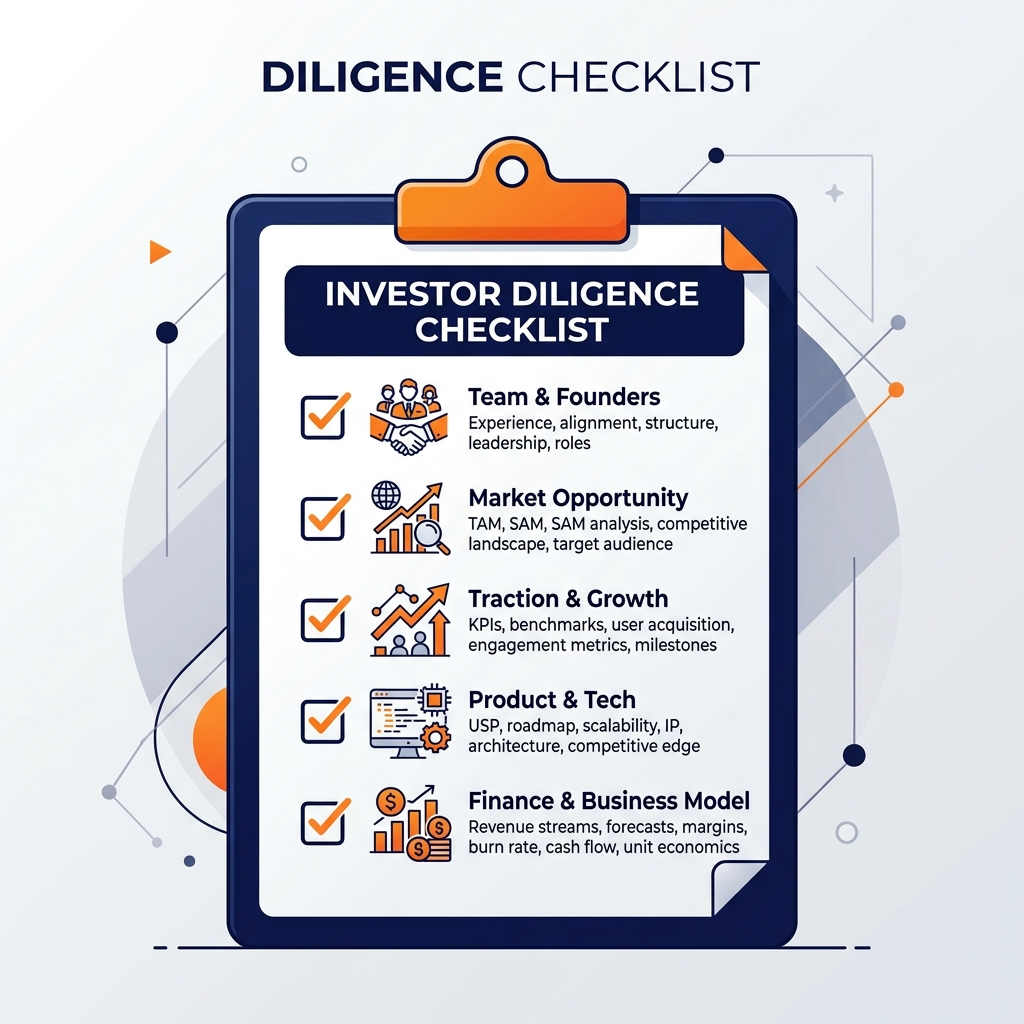
This guide goes deep into the 10 criteria that Indian seed investors consistently evaluate before writing a cheque. Not what they say in public. Not the polished frameworks from VC blogs. What actually moves the needle in an Indian investor's mind when they are deciding whether to back your startup.
How Indian Seed-Stage Investors Think Differently
Before diving into the criteria, it is worth understanding the specific context of Indian seed investing in 2026 — because it has some important differences from the US market that most Indian founders model their fundraising approach on.
- Indian seed investors are generally more conservative about valuations than their US counterparts — a ₹15 crore post-money seed valuation requires significantly more justification in India than a $4 million post-money seed in Silicon Valley
- Relationship and credibility matter more in Indian fundraising — a warm introduction carries significantly more weight in India than a cold email, regardless of how good the pitch is
- Profitability pathway matters even at seed stage — Indian investors have been burned by high-burn, slow-to-profit models and now routinely ask about the path to positive unit economics from the first meeting
- The Indian market context is unique — investors want to see that you understand the specific nuances of Indian consumer behaviour, infrastructure constraints, payment patterns, and distribution challenges
- Founder reputation compounds — India's startup ecosystem is smaller and more interconnected than Silicon Valley; what investors hear about you from other founders and advisors matters enormously
💡 Key Context: In India, the pre-seed and seed funding decision is heavily influenced by the quality of a founder's preparation — not just the quality of their idea. A mediocre idea with exceptional documentation, financial rigour, and investor-ready materials often outperforms a brilliant idea presented poorly. This is where ConsultUp India's advisory work has the most direct impact.
<w:bottom w:val="single" w:color="1A3C6E" w:sz="12" w:space="4"/><w:left w:val="single" w:color="1A3C6E" w:sz="40" w:space="8"/><w:right w:val="single" w:color="1A3C6E" w:sz="12" w:space="4"/></w:pBdr><w:spacing w:before="200" w:after="180"/><w:ind w:left="360"/></w:pPr><w:r><w:rPr><w:rFonts w:ascii="Arial" w:cs="Arial" w:eastAsia="Arial" w:hAnsi="Arial"/><w:b/><w:bCs/><w:color w:val="1A3C6E"/><w:sz w:val="27"/><w:szCs w:val="27"/></w:rPr><w:t xml:space="preserve">👥 Criterion 1: The Founding Team — Investors bet on people before they bet on ideas
At the pre-seed and seed stage, the product is unfinished, the market is unproven, and the business model is hypothetical. The one thing that is real — and that will either execute or fail across every challenge ahead — is the founding team. This is why most experienced seed investors say they invest in people, not ideas.
What Investors Actually Look For in the Team
- Founder-market fit: Have you spent significant time — years, ideally — deeply embedded in the problem you are solving? A founder who worked in supply chain logistics for 8 years has a structural advantage over a generalist founder entering the space.
- Complementary skills: The most fundable founding teams combine technical depth (product/engineering) with commercial capability (sales/distribution/market) in the same founding group. Solo founders and teams of three engineers with no commercial lead consistently face harder fundraising conversations.
- Prior execution evidence: Not necessarily prior startup experience — but clear evidence that you have taken something from zero to one in your professional life. A track record of execution is more compelling than a track record of ideas.
- Coachability and self-awareness: Investors spend 1–2 hours with founders before making a multi-year commitment. They are evaluating whether you listen, whether you update your views when presented with evidence, and whether you know what you do not know.
- Resilience signals: Founders who have faced and overcome professional or personal adversity — and can articulate what they learned — are consistently rated higher. Investors are implicitly asking: will this person quit when things get hard?
- Team stability: A founding team that has worked together before, or that has a clear reason for coming together (co-founders who met building something related), signals lower execution risk than strangers who met at a hackathon three months ago.
The Question Investors Are Really Asking
Beneath every team-related question in an investor conversation is a single underlying question: if everything about this business turns out to be different from what you have presented today — different market dynamics, different competitive landscape, different customer behaviour — is this the team that will figure it out?
Your job is to answer that question convincingly — not through confidence, but through demonstrated evidence of how you think, how you have executed, and how you respond to challenges.
⚠️ Red Flag: Founding teams where every co-founder has the same background — three IIT engineers, three IIM MBAs, three former consultants — consistently receive harder scrutiny. Homogeneous founding teams signal a potential blind spot in the skills needed to build a complete business. Acknowledge the gap and explain your plan to address it.
<w:bottom w:val="single" w:color="6B2FA0" w:sz="12" w:space="4"/><w:left w:val="single" w:color="6B2FA0" w:sz="40" w:space="8"/><w:right w:val="single" w:color="6B2FA0" w:sz="12" w:space="4"/></w:pBdr><w:spacing w:before="200" w:after="180"/><w:ind w:left="360"/></w:pPr><w:r><w:rPr><w:rFonts w:ascii="Arial" w:cs="Arial" w:eastAsia="Arial" w:hAnsi="Arial"/><w:b/><w:bCs/><w:color w:val="6B2FA0"/><w:sz w:val="27"/><w:szCs w:val="27"/></w:rPr><w:t xml:space="preserve">🎯 Criterion 2: The Problem — Is this a real, painful, and urgent problem worth solving?
The quality of the problem you are solving is the foundation of everything else. A large, painful, and urgent problem does not guarantee success — but a small, mild, or non-existent problem guarantees failure.
Indian seed investors evaluate the problem along three dimensions:
Pain Intensity
How painful is this problem for the people who experience it? An investor wants to see evidence that your target customers experience this problem acutely — not occasionally, not mildly, but as a genuine friction in their life or business that they are actively trying to solve, often with inadequate alternatives.
- Strongest evidence: Customers who are already spending money on inadequate substitutes — showing willingness to pay and urgency
- Good evidence: Customer interviews where people describe the problem in emotional, specific terms with concrete examples of its impact
- Weak evidence: Survey data showing that a percentage of respondents 'experience this challenge' — this is almost always insufficient
Problem Frequency
How often does this problem occur? A problem that happens once a year — even a painful one — has a smaller opportunity than a problem that occurs daily or weekly. Frequency drives both market size and the retention economics of any solution.
Market Timing
Why is now the right time to solve this problem? The best problems to solve in 2026 are ones where a recent change — in technology, regulation, consumer behaviour, infrastructure, or market structure — has either created the problem for the first time or made it newly solvable in a way it was not before.
💡 Pro Tip: Investors call this 'the why now question' — and it is one of the most important in any seed pitch. A strong answer references a specific recent catalyst: the UPI-enabled payment layer that makes micro-transactions viable, the ONDC network that changes B2B commerce distribution, the post-COVID shift in rural digital adoption. Identify and articulate your specific catalyst clearly.
<w:bottom w:val="single" w:color="0D6E6E" w:sz="12" w:space="4"/><w:left w:val="single" w:color="0D6E6E" w:sz="40" w:space="8"/><w:right w:val="single" w:color="0D6E6E" w:sz="12" w:space="4"/></w:pBdr><w:spacing w:before="200" w:after="180"/><w:ind w:left="360"/></w:pPr><w:r><w:rPr><w:rFonts w:ascii="Arial" w:cs="Arial" w:eastAsia="Arial" w:hAnsi="Arial"/><w:b/><w:bCs/><w:color w:val="0D6E6E"/><w:sz w:val="27"/><w:szCs w:val="27"/></w:rPr><w:t xml:space="preserve">💡 Criterion 3: Solution and Differentiation — Why your approach — and not every other approach?
Many founders make the mistake of spending most of their pitch on the solution — its features, its technology, its design. Investors spend relatively little time on the solution in the first meeting. They spend a lot of time on the differentiation.
The question is not 'does your solution work?' The question is: 'why will your solution win against everyone else working on this problem, including the incumbents, the well-funded competitors, and the ones we have not heard of yet?'
The Four Types of Differentiation Indian Investors Respect
- Technology moat: You have built something technically difficult that takes significant time to replicate — a proprietary algorithm, a unique dataset, a hardware component with a manufacturing barrier. This is the strongest moat but also the rarest.
- Distribution moat: You have access to a distribution channel that competitors cannot easily replicate — an exclusive partnership, a community, a regulatory relationship, or a network effect that compounds over time.
- Data moat: Your product generates data that makes it progressively better than competitors as it scales — and that data advantage is not available to anyone starting from zero today.
- Execution moat: Your team's specific domain expertise, operational experience, or relationships give you a 12–24 month head start that matters in a fast-moving market. This is the most common early-stage moat — and the one that requires the most credible team story to support.
What to Avoid When Presenting Your Differentiation
- Claiming no competition: Every problem has existing solutions — including the current 'do nothing' behaviour. Saying you have no competition signals either poor market research or a lack of genuine market opportunity.
- Feature-based differentiation only: 'We have 3 more features than the incumbent' is not a moat. Features are copied in weeks. Focus on structural, compounding advantages.
- Vague 'better, faster, cheaper' claims without data: Investors hear this constantly. Quantify your differentiation — 40% lower cost to serve, 3x faster onboarding, 60% better retention — with credible methodology.
<w:bottom w:val="single" w:color="1A6E3C" w:sz="12" w:space="4"/><w:left w:val="single" w:color="1A6E3C" w:sz="40" w:space="8"/><w:right w:val="single" w:color="1A6E3C" w:sz="12" w:space="4"/></w:pBdr><w:spacing w:before="200" w:after="180"/><w:ind w:left="360"/></w:pPr><w:r><w:rPr><w:rFonts w:ascii="Arial" w:cs="Arial" w:eastAsia="Arial" w:hAnsi="Arial"/><w:b/><w:bCs/><w:color w:val="1A6E3C"/><w:sz w:val="27"/><w:szCs w:val="27"/></w:rPr><w:t xml:space="preserve">📊 Criterion 4: Market Size and Opportunity — Is this worth building a venture-scale business around?
This is the criterion where Indian founders most consistently go wrong — either by overstating the market with inflated global statistics, or by understating it by being too conservative about India's growth trajectory.
Seed investors in India are looking for startups that can credibly address a market large enough to justify a ₹50–500 crore revenue business within 7–10 years. That typically means:
- A TAM (Total Addressable Market) in India of at least ₹1,000–2,000 crore — ideally significantly larger
- A SAM (Serviceable Addressable Market) that is a credible subset of the TAM — defined by your specific segment, geography, and product scope
- A SOM (Serviceable Obtainable Market) that shows what you can realistically capture in 3–5 years with the capital you are raising
How to Size the Market in a Way That Is Actually Credible
Bottom-up market sizing is almost always more credible than top-down. Instead of starting with 'the Indian fintech market is worth ₹100,000 crore and we will capture 1%', build the number from the ground up:
- Define your ideal customer precisely: Industry, company size, geography, use case.
- Estimate the total number of such customers in India: Use census data, MSME registry, industry reports, or your own primary research.
- Multiply by your expected revenue per customer: Average deal size, annual subscription value, or transaction volume.
- Show the growth driver: Why will this number of addressable customers grow over the next 5 years?
💡 Indian Market Specificity: The best market sizing pitches in India ground their numbers in India-specific data sources — IBEF sector reports, NASSCOM studies, RBI data, census figures, and Mospi statistics — rather than global market reports divided by population. India-specific data shows that you understand the nuances of the market you are actually addressing.
The Venture Scale Question
Indian seed investors are implicitly asking: can this become a ₹100 crore+ revenue business, and is there a credible path to that scale from where you are today? If the honest answer is no — if the market ceiling is ₹20 crore even in the best case — this is a great lifestyle business but not a venture-scale investment.
Knowing this distinction and being honest about it saves everyone time and helps you approach the right type of capital.
<w:bottom w:val="single" w:color="E8712A" w:sz="12" w:space="4"/><w:left w:val="single" w:color="E8712A" w:sz="40" w:space="8"/><w:right w:val="single" w:color="E8712A" w:sz="12" w:space="4"/></w:pBdr><w:spacing w:before="200" w:after="180"/><w:ind w:left="360"/></w:pPr><w:r><w:rPr><w:rFonts w:ascii="Arial" w:cs="Arial" w:eastAsia="Arial" w:hAnsi="Arial"/><w:b/><w:bCs/><w:color w:val="E8712A"/><w:sz w:val="27"/><w:szCs w:val="27"/></w:rPr><w:t xml:space="preserve">📈 Criterion 5: Traction and Validation — What proof do you have that this is real?
Traction is the single most powerful signal a pre-seed or seed-stage founder can show. Every investor says they invest in teams and markets — but traction is what moves a conversation from 'interesting' to 'let us talk terms'.
In India's seed market in 2026, traction does not necessarily mean revenue. It means evidence — any credible, specific evidence — that real people in your target market value what you are building.
The Traction Hierarchy: What Carries the Most Weight
Traction Type
Signal Strength
What It Proves
Paying customers + retention
⭐⭐⭐⭐⭐ Strongest
Real willingness to pay + product value
Paid pilots or LOIs with revenue commitment
⭐⭐⭐⭐
Commercial validation, not just interest
Active users with strong engagement/retention
⭐⭐⭐⭐
Product-market fit signals without revenue
Letters of Intent (non-binding)
⭐⭐⭐
Directional interest; weak without follow-through
Waitlist with conversion rate data
⭐⭐⭐
Demand signal; needs conversion evidence
User interviews and survey data
⭐⭐
Qualitative validation; easy to interpret favourably
Prototype with no users
⭐
Technical feasibility only — not market validation
How to Present Traction That You Have (At Every Stage)
Pre-revenue founders often assume they have nothing to show. This is almost never true. Here is how to extract and present maximum signal from whatever validation you have:
- If you have paying customers: Show MRR, customer count, average deal size, growth rate, and — most importantly — retention and repeat purchase data. Investors care more about retention than acquisition.
- If you have active users but no revenue: Show DAU/MAU ratio, session length, feature engagement depth, and NPS. A product with 500 weekly active users who return every day is more fundable than one with 5,000 downloads and 10% monthly active.
- If you have pilots or LOIs: Show the total contracted or committed revenue, the names of the organisations (if permitted), and the timeline to conversion. An LOI from a Tata Group company or a government department carries significant signal.
- If you have nothing yet: Do not hide this. Show your customer discovery process — how many conversations you have had, specific quotes from potential customers, and the specific validation activities you will fund with this investment.
⚠️ Common Mistake: Inflating traction numbers is one of the fastest ways to permanently damage your reputation with an Indian investor. Indian VCs talk to each other, and they fact-check. A founder who claims 1,000 paying users and cannot show bank statements or platform data to back it up will never raise from that network again. Present exactly what you have — the context and the story matter as much as the number.
<w:bottom w:val="single" w:color="9A6F00" w:sz="12" w:space="4"/><w:left w:val="single" w:color="9A6F00" w:sz="40" w:space="8"/><w:right w:val="single" w:color="9A6F00" w:sz="12" w:space="4"/></w:pBdr><w:spacing w:before="200" w:after="180"/><w:ind w:left="360"/></w:pPr><w:r><w:rPr><w:rFonts w:ascii="Arial" w:cs="Arial" w:eastAsia="Arial" w:hAnsi="Arial"/><w:b/><w:bCs/><w:color w:val="9A6F00"/><w:sz w:val="27"/><w:szCs w:val="27"/></w:rPr><w:t xml:space="preserve">💰 Criterion 6: Business Model and Unit Economics — How does this become a profitable business at scale?
Indian seed investors in 2026 are markedly more focused on unit economics than their counterparts were five years ago. The era of 'grow at any cost' is over in the Indian market. Investors want to see a clear, credible path to positive unit economics — even if profitability is still years away.
The Unit Economics Questions Every Investor Will Ask
- Customer Acquisition Cost (CAC): How much does it cost, in total, to acquire one paying customer? This includes all sales and marketing expenditure divided by new customers acquired in the period.
- Lifetime Value (LTV): How much revenue does an average customer generate over their entire relationship with your product? This is a function of average revenue per customer and average customer lifetime (inverse of churn rate).
- LTV:CAC Ratio: The ratio of lifetime value to acquisition cost. Below 1:1 means you lose money on every customer. A ratio of 3:1 or higher is the standard seed investor benchmark for a healthy business model in India.
- CAC Payback Period: How many months does it take to recoup your customer acquisition cost from gross profit? Under 12 months is strong; under 18 months is acceptable at seed stage; beyond 24 months requires a very compelling LTV story.
- Gross Margin: What percentage of revenue remains after direct costs of delivering your product or service? SaaS businesses should target 70%+; marketplaces 30–50%; hardware much lower. Gross margin determines how much of your revenue can eventually become operating profit.
What If You Are Pre-Revenue?
If you do not yet have revenue, you cannot show actual unit economics — but you must still show unit economic thinking. This means:
- Presenting your modelled CAC based on the specific channels you will use and comparable benchmarks from similar Indian startups
- Estimating LTV from customer conversation data — what are potential customers currently spending on the problem you solve, and how long do they stay with similar products?
- Identifying your gross margin structure based on your cost of service delivery — especially for services, manufacturing, or marketplace models
💡 Pro Tip: Investors are not expecting perfect unit economics at pre-seed stage. They are expecting unit economic awareness. A founder who says 'we estimate a ₹3,000 CAC via digital channels based on industry benchmarks, against a ₹15,000 year-one LTV at 40% annual churn, giving us an LTV:CAC of 5:1 — but we will validate this in the first three months of deployment' is far more fundable than one who says 'our unit economics will be great once we scale'.
<w:bottom w:val="single" w:color="0D6E6E" w:sz="12" w:space="4"/><w:left w:val="single" w:color="0D6E6E" w:sz="40" w:space="8"/><w:right w:val="single" w:color="0D6E6E" w:sz="12" w:space="4"/></w:pBdr><w:spacing w:before="200" w:after="180"/><w:ind w:left="360"/></w:pPr><w:r><w:rPr><w:rFonts w:ascii="Arial" w:cs="Arial" w:eastAsia="Arial" w:hAnsi="Arial"/><w:b/><w:bCs/><w:color w:val="0D6E6E"/><w:sz w:val="27"/><w:szCs w:val="27"/></w:rPr><w:t xml:space="preserve">🗺️ Criterion 7: Go-to-Market Strategy — How will you reach and convert your first 1,000 customers?
Vision is cheap. Distribution is expensive and hard. Indian seed investors know this — and they scrutinise go-to-market strategies with particular rigour because most early-stage Indian startups have excellent product vision and weak distribution planning.
A strong GTM strategy at seed stage is not a five-year marketing plan. It is a specific, executable, resource-matched plan for acquiring your first 100 to 1,000 customers — with clear channel assumptions, conversion rate estimates, and cost per acquisition benchmarks.
What a Strong Seed-Stage GTM Looks Like
- Channel specificity: Not 'digital marketing and partnerships' but 'LinkedIn outreach to CFOs of mid-size manufacturing companies, targeting 20 conversations per week at a 15% conversion to demo, based on our current 3-person sales team capacity'
- Bottoms-up acquisition math: A specific calculation showing how your target number of customers in Year 1 is achievable with the team and budget you have — not just an aspiration
- Early distribution insight: An unfair distribution advantage — a community, a partner network, a regulatory relationship, or a co-founder with direct customer access — that competitors cannot easily replicate
- Customer profile precision: A specific description of your ideal first customer — industry, company size, job title of the buyer, geography, trigger event that causes them to search for a solution — not a generic 'small businesses in India'
- Phase sequencing: A clear explanation of how you go from Phase 1 (first 100 customers via direct sales) to Phase 2 (first 1,000 customers via channel partners or self-serve) — what needs to be true before you unlock the next distribution layer
⚠️ The GTM Trap: The most common GTM mistake in Indian seed pitches is proposing an expensive, complex acquisition strategy — paid social, SEO, influencer marketing, field sales team — before demonstrating that even one customer can be acquired at an acceptable CAC. Seed investors want to see that you have found one channel that works before you scale. Show them the working channel first, then the scale plan.
<w:bottom w:val="single" w:color="1A6E3C" w:sz="12" w:space="4"/><w:left w:val="single" w:color="1A6E3C" w:sz="40" w:space="8"/><w:right w:val="single" w:color="1A6E3C" w:sz="12" w:space="4"/></w:pBdr><w:spacing w:before="200" w:after="180"/><w:ind w:left="360"/></w:pPr><w:r><w:rPr><w:rFonts w:ascii="Arial" w:cs="Arial" w:eastAsia="Arial" w:hAnsi="Arial"/><w:b/><w:bCs/><w:color w:val="1A6E3C"/><w:sz w:val="27"/><w:szCs w:val="27"/></w:rPr><w:t xml:space="preserve">📋 Criterion 8: Financial Projections and Use of Funds — Does the ask make logical sense?
Financial projections at the seed stage are not forecasts. Everyone knows they will be wrong. They are a communication tool — a structured way of showing investors how you think about your business financially, what assumptions drive your model, and whether your funding ask is rational and milestone-linked.
What Investors Examine in Your Financial Model
- Assumption quality: Are your revenue growth assumptions grounded in your GTM plan and current traction? Are your cost assumptions based on real quotes or genuine industry benchmarks? Or are they derived by working backwards from a target revenue number?
- Internal consistency: Does the headcount in your HR plan match the revenue growth in your revenue model? Does your CAC assumption match your marketing budget? Inconsistencies signal that the model was assembled rather than built.
- Milestone linkage: Can you clearly explain which specific milestones the seed capital will fund — and why those milestones are the right ones to pursue before raising the next round?
- Use of funds clarity: Investors want to see a specific breakdown — not 'product and marketing' but '40% product development (2 engineers and 1 designer), 35% sales and customer acquisition, 15% operations, 10% admin'. The specificity signals that you have thought through exactly what you are buying with their capital.
- Runway calculation: How many months of runway does the raise provide at your projected burn rate? The standard benchmark for a seed round is 18–24 months of runway to reach the next fundable milestone.
- Path to next milestone: What specific, measurable milestones will you achieve by the time this capital runs out — and why are those milestones sufficient to raise a follow-on round at a higher valuation?
💡 ConsultUp Insight: At ConsultUp India, we build financial models for seed-stage startups that are specifically designed to answer these investor questions — not just to show pretty revenue curves. Every assumption in the model is documented and defensible. Every use-of-funds line is tied to a specific hire, tool, or activity. This level of financial rigour is what separates the decks that get funded from the ones that get admired and passed.
<w:bottom w:val="single" w:color="6B2FA0" w:sz="12" w:space="4"/><w:left w:val="single" w:color="6B2FA0" w:sz="40" w:space="8"/><w:right w:val="single" w:color="6B2FA0" w:sz="12" w:space="4"/></w:pBdr><w:spacing w:before="200" w:after="180"/><w:ind w:left="360"/></w:pPr><w:r><w:rPr><w:rFonts w:ascii="Arial" w:cs="Arial" w:eastAsia="Arial" w:hAnsi="Arial"/><w:b/><w:bCs/><w:color w:val="6B2FA0"/><w:sz w:val="27"/><w:szCs w:val="27"/></w:rPr><w:t xml:space="preserve">⚔️ Criterion 9: Competitive Landscape — Do you understand the battlefield — and your position on it?
How founders talk about competition tells investors a great deal about their market understanding and their intellectual honesty. The two extremes — 'we have no competition' and 'here is a 2x2 matrix that shows we are superior on every dimension' — are both red flags.
How to Present Competition Correctly
The right approach to the competition slide is to demonstrate that you have done genuine, rigorous competitive research and that you have a clear, specific answer to the question: 'why will customers choose you over the existing alternatives?'
- Map the full competitive landscape: Direct competitors (same solution, same customer), indirect competitors (different solution, same problem), and the 'do nothing' option (customers who currently tolerate the pain without any solution)
- Be honest about incumbents' strengths: Acknowledging that a large incumbent has distribution, brand, and capital advantages — and then explaining why you can still win — is far more credible than pretending they do not matter
- Identify your specific wedge: The specific customer segment, use case, or geography where you will win first — before competing across the whole market. The best seed-stage competitive stories are about focused wedges, not full-market challenges.
- Explain why now favours you: A specific market change — regulatory, technological, or behavioural — that disadvantages incumbents and favours a new entrant like you
The Competition Insight That Impresses Indian Investors Most
Investors are most impressed by founders who have spoken to competitor customers — not just prospect customers. If you can say 'we interviewed 25 customers of [Competitor X] and the three most consistent complaints are [specific pain points], which our product addresses by [specific mechanism]' — you have demonstrated a level of market intelligence that most founders never achieve.
<w:bottom w:val="single" w:color="E8712A" w:sz="12" w:space="4"/><w:left w:val="single" w:color="E8712A" w:sz="40" w:space="8"/><w:right w:val="single" w:color="E8712A" w:sz="12" w:space="4"/></w:pBdr><w:spacing w:before="200" w:after="180"/><w:ind w:left="360"/></w:pPr><w:r><w:rPr><w:rFonts w:ascii="Arial" w:cs="Arial" w:eastAsia="Arial" w:hAnsi="Arial"/><w:b/><w:bCs/><w:color w:val="E8712A"/><w:sz w:val="27"/><w:szCs w:val="27"/></w:rPr><w:t xml:space="preserve">🎯 Criterion 10: Clarity of Ask and Vision Alignment — Do you know what you want and why?
The final criterion is often the one founders prepare for least — and the one that determines whether a good investor conversation turns into a closed deal.
Clarity of ask means being able to answer, without hesitation, four questions that every serious investor will ask before writing a cheque:
Question 1: How much are you raising and at what valuation?
Give a specific number for both. 'We are raising between ₹50 lakh and ₹1.5 crore' signals indecision. 'We are raising ₹1 crore at a ₹6 crore post-money valuation via SAFE note' signals that you have thought through your capital needs and your valuation methodology. Have a justification for both numbers.
Question 2: What instrument are you offering?
Equity, SAFE note, convertible note, or compulsorily convertible debenture (CCD) — each has different implications. Know which instrument you are offering, why, and what the key terms are (valuation cap, discount rate, interest rate). Founders who do not know the answer to this question immediately signal a lack of fundraising readiness.
Question 3: What will you achieve with this capital in 18 months?
Name 3 specific, measurable milestones. Not 'we will grow revenue' but 'we will reach ₹25 lakh MRR, onboard 5 enterprise pilot customers, and launch our mobile application'. These milestones should be the ones that will allow you to raise a follow-on round at a 3–5x higher valuation.
Question 4: What is your 5-year vision?
Not a revenue target — a vision of what the world looks like if your startup succeeds. The best founders can articulate a specific, ambitious, and credible future state that resonates emotionally as well as financially. This is where investor conviction is ultimately built.
💡 ConsultUp Insight: The founders who close their rounds fastest in India are almost always the ones with the clearest ask — who know exactly how much they are raising, at what valuation, on what instrument, for which milestones, and what the 5-year picture looks like. This clarity does not come from confidence alone. It comes from preparation. And preparation is exactly what ConsultUp India is built to provide.
The 10 Investor Criteria: Quick Reference Scorecard
Use this to honestly self-assess your fundraising readiness before approaching investors:
Criterion
Strong Signal
Weak Signal
Team
Domain expertise + complementary skills + execution track record
Homogeneous team, no relevant experience, no prior execution
Problem
High pain intensity, frequent occurrence, strong 'why now'
Mild inconvenience, rare occurrence, no market catalyst
Solution
Clear structural moat — tech, data, distribution, or execution
Feature list with no defensible differentiation
Market Size
₹1,000Cr+ TAM with bottom-up methodology and India-specific data
Global stats divided by population, vague sizing
Traction
Paying customers, strong retention, or committed LOIs
Downloads, signups, or 'positive user feedback'
Business Model
LTV:CAC 3:1+, CAC payback under 18 months, clear gross margin
No unit economic thinking, 'will figure out at scale'
Go-to-Market
Specific channel, conversion data, early distribution insight
Generic 'digital marketing and partnerships'
Financials
Assumption-driven model, clear milestone linkage, 18M+ runway
Top-down hockey stick, no use-of-funds detail
Competition
Honest landscape mapping, specific wedge, competitor interviews
'No competition' or superficial 2x2 matrix
Clarity of Ask
Specific amount, valuation, instrument, milestones, 5Y vision
Vague range, no valuation anchor, unclear use of funds
The Meta-Factor: What Ties All 10 Criteria Together
Across all 10 criteria, experienced Indian seed investors are evaluating one underlying thing: the quality of your thinking.
Not the quality of your idea — the quality of your thinking about the problem, the market, the customer, the solution, the competition, and the business model. A founder who thinks rigorously, updates their views with evidence, knows what they do not know, and can communicate all of this clearly is the founder who gets funded.
The pitch deck is not the goal. The financial model is not the goal. The goal is to demonstrate, through every element of your investor interactions, that you are the kind of person who thinks clearly enough and executes consistently enough to make a return on their capital.
Everything else — the deck, the model, the traction, the market sizing — is evidence in service of that demonstration.
How ConsultUp India Prepares Founders to Meet These Criteria
Understanding what investors look for is the first step. Demonstrating it convincingly across a pitch deck, a financial model, and a live investor conversation is an entirely different challenge.
At ConsultUp India, our investor readiness services are designed specifically around these 10 criteria:
- Investor-grade pitch deck: Structured to address all 10 investor criteria in sequence — with the right narrative arc, the right data, and the right level of detail for seed-stage conversations
- Financial model with documented assumptions: Built from the ground up with your specific business metrics — not a template with your numbers pasted in
- Mock pitch and Q&A sessions: Realistic investor rehearsals based on the specific objections and questions that seed investors in your sector typically raise
- Competitive landscape analysis: We help you map your competition honestly and identify your specific, defensible wedge
- GTM strategy refinement: We review your go-to-market plan for specificity, channel logic, and acquisition math
- Investor introductions: Curated warm introductions to angels, seed VCs, and PE firms from our 250+ investor network — matched to your specific stage, sector, and raise size
Our Incubation Pro+ package (₹50,000) and Accelerator package (₹70,000) are specifically designed for founders who are at the MVP to early traction stage and are ready to pursue institutional investment with full preparation support.
<w:bottom w:val="single" w:color="1A3C6E" w:sz="6" w:space="4"/><w:left w:val="single" w:color="1A3C6E" w:sz="6" w:space="4"/><w:right w:val="single" w:color="1A3C6E" w:sz="6" w:space="4"/></w:pBdr><w:spacing w:before="160" w:after="160"/><w:jc w:val="center"/></w:pPr><w:r><w:rPr><w:rFonts w:ascii="Arial" w:cs="Arial" w:eastAsia="Arial" w:hAnsi="Arial"/><w:b/><w:bCs/><w:sz w:val="22"/><w:szCs w:val="22"/></w:rPr><w:t xml:space="preserve">📋 Want to know how investor-ready your startup is right now? Visit consultupindia.com or call 1800-202-1945 for a free investor readiness assessment.
Final Thoughts
The gap between startups that get funded at pre-seed and seed stage in India and those that do not is rarely about the quality of the idea. It is almost always about the quality of the preparation — how well the founder understands their market, how rigorously they have thought through their business model, how honestly they have assessed the competition, and how clearly they can communicate all of this in the pressure of an investor conversation.
The 10 criteria in this guide are not a checklist to game. They are a framework for thinking clearly about your own business — for identifying where your story is genuinely strong and where it needs more work before you sit across the table from a serious investor.
The founders who succeed in India's seed funding market are the ones who do that honest assessment early — and then do the preparation work that most founders are too impatient or too nervous to do.
That preparation is exactly what ConsultUp India is here to help you build.
Tags: what investors look for India, seed funding India 2026, pre-seed investor criteria, startup pitch India, angel investor criteria India, founder market fit, unit economics LTV CAC India, seed stage funding checklist, ConsultUp India investor readiness
© 2026 ConsultUp India (CISPL Conzultupindia Services Private Limited) | consultupindia.com
Ready to become funding-ready?
Book a free consultation and we’ll map your funding roadmap — grants, investors, and compliance in one plan.
Book a call# Keep reading
How to Find the Right Angel Investor or PE Firm for Your Startup in India
Every Indian founder knows the feeling. You have built something real. You have a product, early users, maybe even revenue. You know you need capital to grow — and…