
Why Startups Fail to Raise Funding (And How to Fix It Before Your Next Pitch)
Introduction
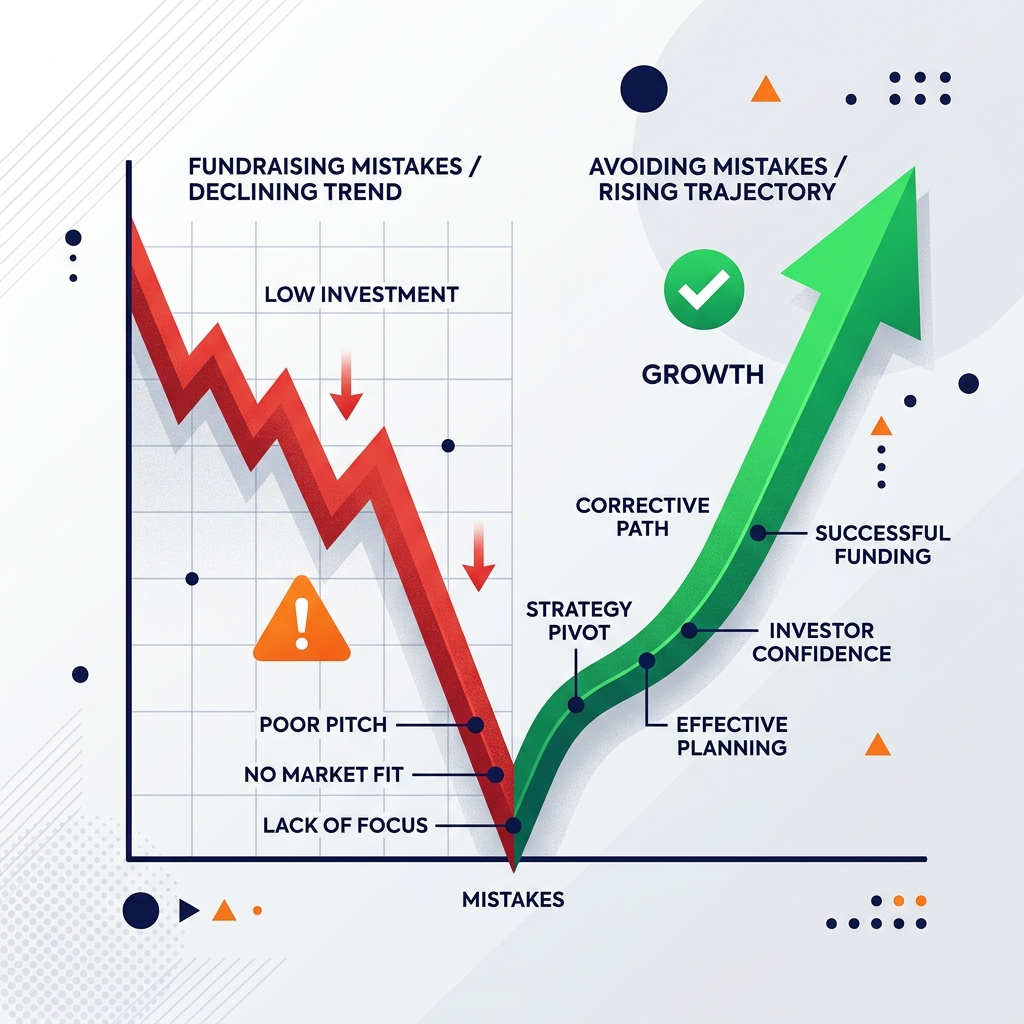
Rejection is the default state of startup fundraising.
The average Indian startup founder sends out 50 to 150 pitch decks before closing their first round. Most of those pitches receive no response. Some receive polite passes. A handful generate follow-up conversations — and even fewer convert into actual investments.
The founders who interpret every rejection as proof that their startup is not fundable are making the most expensive mistake in their entrepreneurial journey. Most funding rejections have nothing to do with the fundamental viability of the business. They are the result of specific, identifiable, fixable failures in how the startup is being presented, positioned, and pitched.
Fundraising failure is almost always a preparation problem, not a business problem. And preparation problems can be diagnosed and fixed — systematically, before the next pitch.
This guide breaks down the 12 most common reasons Indian startups fail to raise funding — and for each one, provides the specific fix that transforms a rejectable pitch into a fundable one. Whether you have already been rejected or are preparing for your first investor conversations, this is the most honest guide to fundraising failure you will find.
The Honest Reality of Startup Fundraising in India
Before diving into the failure reasons, let us acknowledge the landscape honestly — because most founders have a distorted picture of how fundraising actually works in India.
- Less than 1% of startups that pitch to institutional VCs in India receive funding in any given year
- The average time from first investor conversation to a signed term sheet in India is 3 to 6 months — for founders who ultimately succeed
- Most funding rounds involve 30 to 80 investor conversations before closing — not 5 to 10
- The majority of successful fundraises involve at least one significant pivot in the pitch narrative, the financial ask, or the target investor profile
- Government grants and angel funding together represent a far larger number of funded startups in India than institutional VC — most founders dramatically underestimate non-VC funding paths
💡 Reframe: Rejection is data, not judgement. Every investor pass — especially one with a reason attached — tells you something specific about either your business, your pitch, or your investor targeting. Founders who treat rejections as feedback and iterate systematically are the ones who eventually close. Founders who treat them as verdicts give up.
<w:bottom w:val="single" w:color="CC0000" w:sz="12" w:space="4"/><w:left w:val="single" w:color="CC0000" w:sz="40" w:space="8"/><w:right w:val="single" w:color="CC0000" w:sz="12" w:space="4"/></w:pBdr><w:spacing w:before="200" w:after="180"/><w:ind w:left="360"/></w:pPr><w:r><w:rPr><w:rFonts w:ascii="Arial" w:cs="Arial" w:eastAsia="Arial" w:hAnsi="Arial"/><w:b/><w:bCs/><w:color w:val="CC0000"/><w:sz w:val="26"/><w:szCs w:val="26"/></w:rPr><w:t xml:space="preserve">🎯 Reason 1: Pitching to the Wrong Investors — Stage mismatch kills more deals than bad ideas
The single most common — and most preventable — reason startups fail to raise funding in India is pitching to investors whose mandate, stage focus, sector preference, or cheque size does not match the startup's profile.
A pre-revenue founder pitching to a growth PE firm. An agri-tech startup approaching a fintech-focused VC. A ₹25 lakh raise attempted with a fund whose minimum cheque is ₹2 crore. These are not rejections based on business quality — they are stage and mandate mismatches that waste everyone's time.
Why This Happens
Most founders build their investor list by searching for 'investors in India' or collecting email addresses from funding announcement news — without researching whether the investor actually invests at their stage, in their sector, or at their ask size.
The Fix
- Before approaching any investor, verify three things: the stage they invest at (idea, seed, Series A), the sectors they have actually backed (not just claimed to be interested in), and the cheque size of their recent investments
- Use Tracxn, Crunchbase, Inc42, and VCCircle to research actual deal history — not investor bio pages
- If an investor's last 10 investments are all ₹5 crore+ Series A deals, do not send them your seed deck
- For government grants, check eligibility criteria line by line before applying — sector restrictions, entity age limits, and turnover caps eliminate most applicants who apply without checking
💡 Rule of Thumb: If you cannot explain in one sentence why this specific investor is the right fit for your specific startup — not investors in general, but this investor — do not approach them yet. Do the research first.
<w:bottom w:val="single" w:color="6B2FA0" w:sz="12" w:space="4"/><w:left w:val="single" w:color="6B2FA0" w:sz="40" w:space="8"/><w:right w:val="single" w:color="6B2FA0" w:sz="12" w:space="4"/></w:pBdr><w:spacing w:before="200" w:after="180"/><w:ind w:left="360"/></w:pPr><w:r><w:rPr><w:rFonts w:ascii="Arial" w:cs="Arial" w:eastAsia="Arial" w:hAnsi="Arial"/><w:b/><w:bCs/><w:color w:val="6B2FA0"/><w:sz w:val="26"/><w:szCs w:val="26"/></w:rPr><w:t xml:space="preserve">📄 Reason 2: A Weak or Poorly Structured Pitch Deck — Your deck is your first and often only impression
The pitch deck is the most scrutinised document in startup fundraising — and the one most founders underinvest in. A weak deck does not just fail to impress; it actively signals to investors that the founder lacks clarity about their own business.
Indian investors see dozens of decks per week. They make a preliminary judgement within the first 3 to 4 slides. If the problem slide is vague, the market sizing is implausible, or the financial slide is a hockey stick with no supporting logic — the deck is closed and not reopened.
The Most Common Deck Failures
- No clear narrative arc: The slides do not tell a coherent story — problem, solution, market, traction, team, ask — in a logical sequence
- Solution-first structure: Many Indian founders lead with the product, not the problem. Investors need to feel the pain before they can appreciate the painkiller
- Generic market sizing: Quoting global market figures without India-specific data, or using top-down percentages instead of bottom-up calculations
- No differentiation: The solution slide describes features but not the structural reason why this startup wins against competitors
- Weak or absent traction: Pre-revenue founders often skip the traction slide entirely — when they should be showing customer discovery, LOIs, waitlist data, or pilot results
- Unreadable financial slides: A spreadsheet screenshot is not a financial model. Numbers without assumptions, with no clear link to the business model, add no value
- No explicit ask: Founders who do not state clearly what they are raising, at what valuation, and for what milestones leave investors with nothing concrete to act on
The Fix
Every pitch deck should be evaluated against one standard: does this deck answer every significant question a serious investor will have, in the right order, with the right level of evidence? If any section leaves the investor with an unanswered question, that question becomes a reason to pass.
- Structure: Cover → Problem → Solution → Market → Business Model → Traction → GTM → Team → Financials → Ask — in that order
- Length: 12 to 15 slides for the investor deck; 1 page executive summary separately
- Design: Clean, consistent, professional — not a template, not a PowerPoint from 2015
- Test: Have someone with no context on your business read the deck and then answer: what does this company do, who is the customer, and why will it succeed? If they cannot answer accurately, the deck needs work
💡 ConsultUp Insight: At ConsultUp India, a significant portion of our client work involves rebuilding pitch decks that founders believed were ready — and discovering that the problem, differentiation, and financial sections consistently failed to meet the standard that Indian seed investors actually apply. The gap between 'looks good' and 'investor-grade' is larger than most founders realise.
<w:bottom w:val="single" w:color="CC0000" w:sz="12" w:space="4"/><w:left w:val="single" w:color="CC0000" w:sz="40" w:space="8"/><w:right w:val="single" w:color="CC0000" w:sz="12" w:space="4"/></w:pBdr><w:spacing w:before="200" w:after="180"/><w:ind w:left="360"/></w:pPr><w:r><w:rPr><w:rFonts w:ascii="Arial" w:cs="Arial" w:eastAsia="Arial" w:hAnsi="Arial"/><w:b/><w:bCs/><w:color w:val="CC0000"/><w:sz w:val="26"/><w:szCs w:val="26"/></w:rPr><w:t xml:space="preserve">💸 Reason 3: Unrealistic or Indefensible Financials — Hockey sticks without assumptions are fiction, not finance
Financial projections that show ₹0 revenue in Year 1, ₹2 crore in Year 2, and ₹50 crore in Year 3 — with no explanation of what changes between years — are one of the fastest ways to lose investor credibility.
Indian investors have seen this pattern thousands of times. They are not impressed by large numbers. They are impressed by the quality of thinking behind the numbers. A projection that goes from ₹0 to ₹50 crore in two years is not ambitious — it is a red flag that the founder does not understand financial modelling or their own business.
The Most Common Financial Failures
- Top-down projections: 'The market is ₹5,000 crore and we will capture 1%' — with no explanation of how that market share is achieved
- Identical growth rates across all 5 years: Real businesses do not grow at 40% per year for five consecutive years without any variation
- No cost structure: Revenue projections without a matching expense model — salaries, COGS, marketing spend — are not financial models
- No assumptions documented: Investors cannot evaluate projections they cannot trace back to specific, logical assumptions
- Use of funds is vague: 'Product development and marketing' is not a use of funds breakdown — it is a category list
- Founders who cannot defend their own numbers: The worst outcome in an investor meeting is not being able to explain where a figure in your own financial model came from
The Fix
- Build bottom-up: Start from the number of customers you can realistically acquire per month, multiply by average revenue per customer, and derive revenue — not the other way around
- Document every assumption in a separate tab: Every growth rate, every cost per acquisition, every headcount addition should trace back to a specific, named assumption with a rationale
- Build three scenarios: Base, bull, and bear — showing that you have stress-tested the model, not just built the best case
- Map the raise to milestones: Show exactly what milestones ₹X crore of capital will fund, and why those milestones enable a follow-on raise at a higher valuation
- Know every number cold: Before any investor conversation, be able to recall and defend your Year 1 gross margin, your CAC, your LTV:CAC ratio, and your projected cash breakeven date without referencing the deck
<w:bottom w:val="single" w:color="0D6E6E" w:sz="12" w:space="4"/><w:left w:val="single" w:color="0D6E6E" w:sz="40" w:space="8"/><w:right w:val="single" w:color="0D6E6E" w:sz="12" w:space="4"/></w:pBdr><w:spacing w:before="200" w:after="180"/><w:ind w:left="360"/></w:pPr><w:r><w:rPr><w:rFonts w:ascii="Arial" w:cs="Arial" w:eastAsia="Arial" w:hAnsi="Arial"/><w:b/><w:bCs/><w:color w:val="0D6E6E"/><w:sz w:val="26"/><w:szCs w:val="26"/></w:rPr><w:t xml:space="preserve">🧪 Reason 4: No Validation or Weak Traction Story — An idea without proof is a hypothesis, not a business
Investors at every stage — angel, seed, or growth — are in the business of reducing risk. The single most powerful thing a founder can do to reduce investor risk perception is provide evidence that real people care about the problem and want the solution.
Many Indian founders pitch with no external validation whatsoever — no customer conversations, no pilot users, no letters of intent, no waitlist. This is not just a pitch weakness — it signals that the founder has not yet done the most fundamental work of entrepreneurship: testing whether the problem is real.
The Validation Gap
Most founders know they should have traction — but many believe that without a product, there is nothing to show. This is a false constraint. Validation does not require a finished product:
- Problem validation: 30+ customer interviews with documented pain points and specific quotes
- Demand validation: A landing page with a waiting list, even with no product behind it
- Commercial validation: A letter of intent or even an informal email from a potential customer agreeing to pay for the solution once it is built
- Expert validation: An industry expert, mentor, or advisor with domain credentials who publicly endorses the problem and the approach
- Grant validation: A government grant award is one of the most credible third-party validations available — and accessible to idea-stage startups
The Fix
Before your next investor pitch, commit to one specific validation activity that produces external evidence. Not internal conviction — external evidence. The threshold is simple: can you show an investor something that happened in the market that was not created by you telling the market how good your idea is?
- Run 20 customer discovery interviews in two weeks and synthesise the findings into 5 specific, quoted insights
- Launch a landing page and drive 100 to 500 signups before building anything
- Secure one paid pilot or letter of intent from a target customer — even at a heavily discounted rate
- Apply for one government grant — the application process itself forces you to articulate your validation in a structured, evaluable form
⚠️ Critical Warning: Never fabricate or inflate traction data. Indian investors fact-check — they call potential customers, verify MRR with bank statements, and cross-check user numbers with platform analytics. A founder caught misrepresenting traction is permanently blacklisted across the investor network. Present exactly what you have, with context.
<w:bottom w:val="single" w:color="9A6F00" w:sz="12" w:space="4"/><w:left w:val="single" w:color="9A6F00" w:sz="40" w:space="8"/><w:right w:val="single" w:color="9A6F00" w:sz="12" w:space="4"/></w:pBdr><w:spacing w:before="200" w:after="180"/><w:ind w:left="360"/></w:pPr><w:r><w:rPr><w:rFonts w:ascii="Arial" w:cs="Arial" w:eastAsia="Arial" w:hAnsi="Arial"/><w:b/><w:bCs/><w:color w:val="9A6F00"/><w:sz w:val="26"/><w:szCs w:val="26"/></w:rPr><w:t xml:space="preserve">🗺️ Reason 5: No Clear Go-to-Market Plan — Vision without distribution is just a presentation
Many Indian startup pitches are strong on product and weak on distribution. Founders spend months building the product and days thinking about how to sell it — and this imbalance shows up immediately in investor conversations.
A seed investor is not just buying your product. They are buying your plan to acquire customers at scale. If that plan is vague — 'social media marketing and word of mouth' — the investor has no basis for believing that their capital will translate into customer growth.
Common GTM Failures in Indian Pitches
- Channel without math: Naming channels (LinkedIn, Google Ads, partnerships) without showing the conversion rate, CAC, and volume assumption behind each one
- No Phase 1 specificity: A three-year GTM roadmap with no clarity on how the first 100 customers will be acquired
- Assuming virality: 'Our product will grow through word of mouth' is not a GTM plan — it is a hope
- Ignoring the sales cycle: B2B founders often underestimate how long it takes to close their first enterprise customer — and the capital implications of a 6-month sales cycle
- No distribution insight: No unfair advantage in how you reach customers — no community, no partnership, no co-founder with direct access to the target customer segment
The Fix
- Define your Phase 1 channel precisely: One channel, one customer profile, one acquisition mechanism — with the numbers behind it
- Back your CAC assumption with data: Reference industry benchmarks, early pilot data, or comparable startup case studies
- Name your first 10 customers: If you cannot name the 10 specific companies or individuals who will be your first paying customers, you do not yet have a GTM plan — you have a category description
- Identify your distribution wedge: The single most defensible aspect of your go-to-market that competitors cannot easily replicate in the first 12 months
<w:bottom w:val="single" w:color="CC0000" w:sz="12" w:space="4"/><w:left w:val="single" w:color="CC0000" w:sz="40" w:space="8"/><w:right w:val="single" w:color="CC0000" w:sz="12" w:space="4"/></w:pBdr><w:spacing w:before="200" w:after="180"/><w:ind w:left="360"/></w:pPr><w:r><w:rPr><w:rFonts w:ascii="Arial" w:cs="Arial" w:eastAsia="Arial" w:hAnsi="Arial"/><w:b/><w:bCs/><w:color w:val="CC0000"/><w:sz w:val="26"/><w:szCs w:val="26"/></w:rPr><w:t xml:space="preserve">💰 Reason 6: Wrong Valuation Expectations — Over-valuing at the wrong stage destroys deals before they start
Valuation misalignment is one of the quietest and most common reasons Indian founders fail to close funding rounds. The investor likes the business, wants to invest — and then sees a valuation expectation that is disconnected from the stage, the traction, or the market comparables.
In India's seed market in 2026, realistic pre-seed valuations for idea-stage startups with no revenue typically range from ₹2 to ₹6 crore post-money. MVP-stage startups with early traction might command ₹8 to ₹20 crore. Early traction startups with demonstrable MRR and growth can push higher. Founders who walk in expecting ₹50 crore valuations at the pre-revenue stage are almost always pricing themselves out of their own fundraise.
The Fix
- Research comparable valuations: Use Inc42, Tracxn, and LinkedIn to research what similar Indian startups raised at similar stages — this gives you a market-based anchor, not just your own optimism
- Build a valuation methodology: Discounted cash flow, revenue multiple (for post-revenue startups), or comparable transaction analysis — have a methodology, not just a number
- Be flexible on instrument: A SAFE note with a valuation cap and discount rate avoids the valuation negotiation entirely and is increasingly common in Indian seed rounds
- Understand the dilution impact: Model your cap table before and after the round — know exactly what percentage you are selling and what it implies for future rounds
💡 Key Insight: The valuation you accept today determines the dilution you carry into every future round. A ₹2 crore raise at a ₹6 crore post-money valuation means giving up 33% of your company. That same ₹2 crore at a ₹15 crore post-money (achievable with more traction) means giving up only 13%. The difference in founder ownership at Series A is enormous. Do the work to earn the higher valuation before you raise.
<w:bottom w:val="single" w:color="6B2FA0" w:sz="12" w:space="4"/><w:left w:val="single" w:color="6B2FA0" w:sz="40" w:space="8"/><w:right w:val="single" w:color="6B2FA0" w:sz="12" w:space="4"/></w:pBdr><w:spacing w:before="200" w:after="180"/><w:ind w:left="360"/></w:pPr><w:r><w:rPr><w:rFonts w:ascii="Arial" w:cs="Arial" w:eastAsia="Arial" w:hAnsi="Arial"/><w:b/><w:bCs/><w:color w:val="6B2FA0"/><w:sz w:val="26"/><w:szCs w:val="26"/></w:rPr><w:t xml:space="preserve">📬 Reason 7: Spray and Pray Outreach — Sending the same deck to 200 investors is not a strategy
The 'spray and pray' approach to investor outreach — sending the same generic pitch deck to every investor email address found online — is one of the most counterproductive strategies in startup fundraising. It wastes time, damages reputation, and produces almost no results.
Indian VCs and angels receive hundreds of unsolicited decks per week. Most are deleted without being opened. A founder who sends the same deck to 200 investors without any personalisation or targeting is competing in the highest-noise, lowest-signal environment possible.
The Fix
- Warm introductions above all else: A portfolio founder introduction to a VC is worth 50 cold emails. Before every investor approach, exhaust your network for potential introductions
- Personalise every outreach: Three sentences explaining why you are approaching this specific investor — not investors in general — is the minimum standard for any outreach
- Target 20 to 30 investors, not 200: A targeted list of 20 to 30 investors who are genuinely aligned to your stage and sector, approached with personalised outreach, will consistently outperform a cold email blast to 200
- Stage your outreach: Start with your warmest connections. Use early conversations to refine your pitch before approaching your highest-priority targets
- Track every conversation: A deal CRM — even a simple Google Sheet — that tracks every investor, current status, last contact, and next action prevents live deals from falling through the cracks
<w:bottom w:val="single" w:color="0D6E6E" w:sz="12" w:space="4"/><w:left w:val="single" w:color="0D6E6E" w:sz="40" w:space="8"/><w:right w:val="single" w:color="0D6E6E" w:sz="12" w:space="4"/></w:pBdr><w:spacing w:before="200" w:after="180"/><w:ind w:left="360"/></w:pPr><w:r><w:rPr><w:rFonts w:ascii="Arial" w:cs="Arial" w:eastAsia="Arial" w:hAnsi="Arial"/><w:b/><w:bCs/><w:color w:val="0D6E6E"/><w:sz w:val="26"/><w:szCs w:val="26"/></w:rPr><w:t xml:space="preserve">👥 Reason 8: Team Gaps or Credibility Deficits — Investors invest in teams — gaps in the team are gaps in the pitch
At the pre-seed and seed stage, investor conviction is built primarily on the founding team. A founding team that has an obvious, unaddressed capability gap — a pure tech team with no sales or commercial capability, a solo founder without technical co-founders in a deep-tech startup, or a team with no domain experience in the problem they are solving — creates a structural risk that many investors are not willing to accept.
The Most Common Team Credibility Issues
- The all-technical founding team: Three engineers with no one who can sell, market, or manage investor relations
- The solo founder: Not inherently unfundable — but requires a stronger story about how execution risk is managed and who provides accountability and complementarity
- No domain experience: A founding team that entered the sector 3 months ago faces a legitimate question: why you, and not someone who has spent 5 years in this space?
- The advisor-as-replacement strategy: Listing 10 advisors to compensate for missing co-founder capabilities typically does not work — investors know advisors are rarely as engaged as they appear on a deck
The Fix
- Address the gap explicitly: Investors know about the gap. Acknowledging it — and presenting a credible plan to fill it (a specific hire, an active advisor, a co-founder search underway) — is more credible than pretending it does not exist
- Hire or partner before you raise: Even a committed part-time commercial co-founder or a domain expert in an advisory role with a meaningful equity stake (0.5 to 2%) changes the story significantly
- Show domain learning velocity: If you are new to the sector, demonstrate that you have compressed years of domain learning into months — through customer interviews, expert conversations, and market immersion activities
- Prepare your team slide honestly: Every team member's relevance to this specific business should be clear. Generic CVs with impressive institutions but no domain relevance do not build investor confidence
<w:bottom w:val="single" w:color="9A6F00" w:sz="12" w:space="4"/><w:left w:val="single" w:color="9A6F00" w:sz="40" w:space="8"/><w:right w:val="single" w:color="9A6F00" w:sz="12" w:space="4"/></w:pBdr><w:spacing w:before="200" w:after="180"/><w:ind w:left="360"/></w:pPr><w:r><w:rPr><w:rFonts w:ascii="Arial" w:cs="Arial" w:eastAsia="Arial" w:hAnsi="Arial"/><w:b/><w:bCs/><w:color w:val="9A6F00"/><w:sz w:val="26"/><w:szCs w:val="26"/></w:rPr><w:t xml:space="preserve">⏱️ Reason 9: Poor Fundraising Timing and Process — When and how you raise matters as much as what you are raising
Fundraising timing is one of the least discussed and most consequential variables in whether a startup closes a round. Approaching investors too early — before meaningful validation — means facing a market that is simply not ready to fund you yet. Approaching too late — when you are running out of runway — means negotiating from a position of desperation.
The Timing Traps
- Raising when runway is below 3 months: The worst possible negotiating position. Investors smell desperation and either pass or offer punishing terms. Always start fundraising with at least 6 to 9 months of runway remaining
- Raising before milestone achievement: Starting a fundraise before you have hit the milestone that was supposed to justify the raise — then hoping investors will fund potential rather than proof
- No parallel process: Having only one live investor conversation at a time means no competitive tension, no urgency for the investor to move, and a fundraise that can stretch 18 months without closing
- Giving investors too much time: Most investor decisions — especially at seed stage — are made within 4 to 8 weeks of first contact if the investor is genuinely interested. A fundraise that is allowed to drift past 3 months with the same investor rarely closes
The Fix
- Start fundraising 9 months before you need the money: This gives you 3 months to learn from rejections and refine your pitch, 3 months of active investor conversations, and 3 months to close and complete legal documentation
- Run a parallel process: Have 15 to 25 active investor conversations simultaneously, not sequentially. Parallel conversations create momentum and the implicit competitive signal that accelerates decisions
- Set a close date and communicate it: 'We are targeting to close this round in 8 weeks' creates urgency without desperation — and filters out investors who are not ready to move
- Use a lead investor to create social proof: Securing a credible lead investor — even at a small cheque size — dramatically accelerates the other conversations in your pipeline
<w:bottom w:val="single" w:color="1A3C6E" w:sz="12" w:space="4"/><w:left w:val="single" w:color="1A3C6E" w:sz="40" w:space="8"/><w:right w:val="single" w:color="1A3C6E" w:sz="12" w:space="4"/></w:pBdr><w:spacing w:before="200" w:after="180"/><w:ind w:left="360"/></w:pPr><w:r><w:rPr><w:rFonts w:ascii="Arial" w:cs="Arial" w:eastAsia="Arial" w:hAnsi="Arial"/><w:b/><w:bCs/><w:color w:val="1A3C6E"/><w:sz w:val="26"/><w:szCs w:val="26"/></w:rPr><w:t xml:space="preserve">🗣️ Reason 10: Poor Pitch Delivery and Investor Presence — The pitch deck opens the door — how you pitch determines whether you walk through it
A perfect pitch deck presented poorly is still a failed pitch. Indian investors are evaluating not just what you say but how you say it — your clarity of thought under pressure, your ability to listen and respond, your emotional conviction about what you are building, and whether they can imagine spending the next 5 to 7 years working with you as a board member.
Common Pitch Delivery Failures
- Reading from slides: Founders who read their slides aloud signal that they do not know the material deeply enough to speak to it directly — which raises questions about how deeply they know their business
- Over-pitching, under-listening: Great investors ask probing questions. Founders who steamroll through objections or give non-answers to hard questions fail the most important test of the conversation
- Defensive responses to challenges: An investor who pushes back on your market size estimate is not attacking you — they are testing how you think under pressure. The founders who respond with curiosity and evidence rather than defensiveness build far more investor confidence
- No clear ask at the end: Finishing a pitch meeting without stating the ask — how much, at what valuation, on what instrument, closing when — leaves the meeting open-ended in a way that never resolves
- Inability to answer basic financial questions: Not knowing your own unit economics in a live investor conversation is a near-fatal signal of pitch unpreparedness
The Fix
- Practice the pitch 20 times before the first real investor meeting — not with friends who are polite, but with advisors or mentors who will challenge you
- Prepare for the 10 hardest questions in your sector: What is your moat? Why not just build this in-house? What happens when [large competitor] copies you? What have you gotten wrong so far? How do you know the market is this size?
- Conduct mock investor sessions: ConsultUp India's Incubation Pro+ and Accelerator packages include dedicated mock pitch sessions specifically designed to simulate real investor Q&A
- End every meeting with a clear next step: Before leaving, confirm what happens next — will they review the data room this week? Can you schedule a follow-up call in two weeks?
💡 Pro Tip: The single best preparation technique is to pitch to an investor who will definitely say no — a friend who works in VC, a professor, or an advisor — before pitching to your most important targets. The rejection feedback from a consequence-free session is more valuable than any amount of solo deck revision.
<w:bottom w:val="single" w:color="CC0000" w:sz="12" w:space="4"/><w:left w:val="single" w:color="CC0000" w:sz="40" w:space="8"/><w:right w:val="single" w:color="CC0000" w:sz="12" w:space="4"/></w:pBdr><w:spacing w:before="200" w:after="180"/><w:ind w:left="360"/></w:pPr><w:r><w:rPr><w:rFonts w:ascii="Arial" w:cs="Arial" w:eastAsia="Arial" w:hAnsi="Arial"/><w:b/><w:bCs/><w:color w:val="CC0000"/><w:sz w:val="26"/><w:szCs w:val="26"/></w:rPr><w:t xml:space="preserve">📋 Reason 11: Missing or Incomplete Documentation — Undocumented startups look like unready startups
Indian investors increasingly expect a complete, organised data room before they will move past a first conversation. Founders who share a pitch deck but have no financial model, no cap table, no DPIIT certificate, and no incorporation documents ready signal that they are not prepared for the due diligence process — which creates doubt about their readiness to manage institutional capital.
The Documentation Checklist Every Funded Startup Has Ready
- DPIIT recognition certificate — the foundational identity document for Indian startups
- Certificate of Incorporation, PAN, and GST registration
- Pitch deck — investor-grade, current, and consistent with all other documents
- Financial model — 3 to 5-year projections with documented assumptions and three scenarios
- One-page executive summary — for investors who want the TLDR before reading the deck
- Cap table — current ownership structure, any existing investors, option pool
- Historical financial statements — audited if available, bank statements as a minimum
- Traction documentation — screenshots, MRR data, customer contracts or LOIs, user analytics
- Team CVs — specific to the business, not generic LinkedIn profiles
- Any IP documentation — filed patents, trademark registrations, proprietary technology descriptions
The Fix
Build your data room before you start fundraising — not after an investor requests it. A complete, well-organised data room in Google Drive or Notion signals professionalism and reduces friction at every stage of the investor process.
💡 ConsultUp Insight: One of the most common things we hear from investors in ConsultUp India's network is that the quality of a startup's data room is one of the clearest signals of founder quality. A messy, incomplete, or inconsistent data room — even for a great business — creates doubt. A clean, complete, well-organised one accelerates conviction.
<w:bottom w:val="single" w:color="1A6E3C" w:sz="12" w:space="4"/><w:left w:val="single" w:color="1A6E3C" w:sz="40" w:space="8"/><w:right w:val="single" w:color="1A6E3C" w:sz="12" w:space="4"/></w:pBdr><w:spacing w:before="200" w:after="180"/><w:ind w:left="360"/></w:pPr><w:r><w:rPr><w:rFonts w:ascii="Arial" w:cs="Arial" w:eastAsia="Arial" w:hAnsi="Arial"/><w:b/><w:bCs/><w:color w:val="1A6E3C"/><w:sz w:val="26"/><w:szCs w:val="26"/></w:rPr><w:t xml:space="preserve">🔄 Reason 12: Ignoring Government Grants as a Funding Path — The most accessible capital in India goes untouched by most founders
This final reason is specific to the Indian context and consistently underappreciated by founders who have been conditioned to think of fundraising exclusively in terms of angel and VC investment.
Every year, thousands of crores in non-dilutive government grants go unclaimed by Indian startups — not because startups are ineligible, but because founders either do not know the grants exist, assume the process is too complex, or apply with documentation that is not aligned to the evaluation criteria.
Why Founders Skip Government Grants
- 'It is too slow': Government grants take 3 to 9 months from application to disbursement — which feels slow compared to angel funding. But grants are non-dilutive. The capital efficiency difference is significant.
- 'It is too bureaucratic': The documentation requirement is real — but it is manageable with the right guidance and preparation
- 'We do not qualify': Many founders assume they do not qualify without checking. Most DPIIT-recognised startups in sectors from tech to manufacturing to social impact qualify for at least 3 to 5 applicable government schemes
- 'We are focused on investor funding': Non-dilutive capital does not compete with investor funding — it complements it. Government grants before an angel round mean less equity given away, at a higher valuation anchor
The Fix
Before approaching any private investor, complete the following non-dilutive funding checklist:
- Get DPIIT recognition — free, takes 2 to 3 days, unlocks most central government schemes
- Map applicable schemes — central (SISFS, AIM, TIDE 2.0), state (Gujarat SSIP, Karnataka KBITS, Telangana T-Hub), and sector-specific (BIRAC, iDEX, RKVY-RAFTAAR)
- Apply to at least 3 to 5 relevant schemes before your first angel investor conversation
- Use grant award letters as validation evidence in your investor pitch — they are credible third-party proof points
- Stack your funding: government grants + angel investment + CGTMSE loan is a far more capital-efficient structure than equity-only fundraising
💡 ConsultUp Insight: At ConsultUp India, we have watched founders raise their first ₹30 to 50 lakh entirely through government grants — before approaching a single private investor. That non-dilutive capital base, combined with the credibility of government validation, consistently improves their angel round valuation by 30 to 50%. The return on time invested in grant applications is often higher than the return on investor outreach.
Self-Diagnosis: Why Is Your Startup Not Getting Funded?
Use this table to identify which of the 12 reasons is most likely affecting your current fundraising outcomes:
If you are experiencing this...
The likely reason is...
Start with this fix
No responses to outreach
Reason 1 or 7 — wrong investors or spray-and-pray
Rebuild your investor target list; add warm intros
Meetings but no follow-up
Reason 2 or 10 — weak deck or poor pitch delivery
Rebuild deck; run 10 mock pitch sessions
Follow-up but deals not closing
Reason 3, 6, or 9 — financials, valuation, timing
Fix financials; get valuation comp data; set close date
Interest but investor moves slowly
Reason 9 — no urgency, no parallel process
Add 10 parallel conversations; set round close date
Consistent question about team
Reason 8 — team gap or credibility deficit
Address gap explicitly; bring in key advisor or hire
Consistent question about market
Reason 4 or 11 — traction or documentation gap
Add validation activities; build complete data room
Rejection at government grant stage
Reason 3 or 12 — weak DPR or wrong scheme targeting
Rebuild DPR; recheck eligibility; apply to correct scheme
No investor conversations at all
All 12 — need end-to-end fundraising preparation
Contact ConsultUp India for a complete readiness review
The 30-Day Fundraising Preparation Protocol
Whether you are preparing for your first investor pitch or recovering from a failed fundraise, this is the 30-day protocol that transforms a rejectable pitch into a fundable one:
Week 1: Diagnosis and Foundation
- Conduct an honest audit of every investor rejection received — categorise each one by the 12 reasons in this guide
- Verify DPIIT recognition status — if not registered, apply immediately
- Build or update your investor target list — 20 to 30 names with stage, sector, cheque size, and warm introduction path
- Map applicable government schemes and initiate 2 to 3 grant applications
Week 2: Documentation Rebuild
- Rebuild the pitch deck from scratch if it has not closed a round — structure, narrative, and evidence
- Build or update the financial model with documented assumptions and three scenarios
- Write the one-page executive summary
- Organise the complete data room — all documents, consistently named, accessible by link
Week 3: Validation Sprint
- Run 10 to 15 customer discovery or validation conversations and document the insights
- Secure at least one letter of intent, pilot agreement, or formal customer expression of interest
- Collect 3 to 5 specific customer quotes that validate the problem — for use in the pitch
- Identify and approach 2 to 3 domain advisors who will lend credibility to the team slide
Week 4: Pitch Preparation and Launch
- Run 5 mock pitch sessions with challenging advisors — not supportive friends
- Refine the pitch narrative based on the toughest questions from mock sessions
- Initiate warm introduction requests to your highest-priority investor targets
- Launch parallel outreach to 15 to 20 investors simultaneously — not sequentially
How ConsultUp India Helps You Fix Every One of These 12 Reasons
Every failure reason in this guide has a specific, addressable fix — and every fix requires either the right knowledge, the right documentation, or the right connections. ConsultUp India provides all three.
Documentation and Investor Materials
We rebuild pitch decks, financial models, executive summaries, and data rooms to investor-grade standards — addressing the specific weaknesses that are causing rejections in your current pitch.
Government Grant Advisory
We handle the complete grant application process — scheme mapping, DPR preparation, financial projections, application filing, and follow-up — turning the most consistently ignored funding path into a reliable capital source.
Investor Introductions and Mock Sessions
We make warm introductions from our 250+ investor network to angels, seed VCs, and PE firms who match your stage and sector. We also conduct rigorous mock pitch sessions that prepare you for the hardest questions before you face them in a real investor meeting.
Funding Strategy Advisory
We help you build a complete funding roadmap — the right mix of government grants, angel funding, and structured debt at each stage of your startup's journey — so you are always raising the right capital from the right source at the right time.
<w:bottom w:val="single" w:color="1A3C6E" w:sz="6" w:space="4"/><w:left w:val="single" w:color="1A3C6E" w:sz="6" w:space="4"/><w:right w:val="single" w:color="1A3C6E" w:sz="6" w:space="4"/></w:pBdr><w:spacing w:before="160" w:after="160"/><w:jc w:val="center"/></w:pPr><w:r><w:rPr><w:rFonts w:ascii="Arial" w:cs="Arial" w:eastAsia="Arial" w:hAnsi="Arial"/><w:b/><w:bCs/><w:sz w:val="22"/><w:szCs w:val="22"/></w:rPr><w:t xml:space="preserve">🚀 Ready to fix your fundraising? Visit consultupindia.com or call 1800-202-1945 for a free fundraising diagnostic.
Final Thoughts
Funding rejection is painful — but it is not a verdict on the quality of your business or the legitimacy of your ambition. It is almost always feedback about the gap between where your startup is and where it needs to be to meet the risk appetite of the capital you are pursuing.
The founders who close their rounds are not the ones with the best ideas. They are the ones who do the work — the patient, systematic, unglamorous work of building the right documentation, targeting the right investors, validating the right assumptions, and preparing for investor conversations with the same rigour they apply to building their product.
Find the gap. Fix the gap. Show up to the next pitch as a different, better-prepared founder than the one who got rejected last time. That is the only fundraising strategy that reliably works.
Tags: why startups fail to raise funding India, startup fundraising mistakes India, pitch deck rejection India, how to raise funding India, startup funding tips 2026, investor rejection reasons India, ConsultUp India fundraising advisory
© 2026 ConsultUp India (CISPL Conzultupindia Services Private Limited) | consultupindia.com
Ready to become funding-ready?
Book a free consultation and we’ll map your funding roadmap — grants, investors, and compliance in one plan.
Book a call# Keep reading

How to Create an Investor-Ready Pitch Deck for Early-Stage Startups in India (2026 Guide)
You have a great idea. Maybe even a proof of concept. But every time you walk into an investor meeting — or fill out a grant application — you feel like something…
10 Slides Every Startup Pitch Deck Must Have to Impress Indian Investors
You have an idea that could change an industry. Your product works. Your team is committed. But the moment you walk into an investor meeting in India, none of that…