
Bootstrapping vs Angel Funding vs Grants: What's the Right Funding Path for Indian Startups?
Introduction
Every founder reaches a moment where the question is unavoidable: how do I fund this?
And in India in 2026, the answer has never been more complex — or more full of genuine opportunity. You can build with your own money. You can take an angel investor's cheque. You can apply for a government grant. You can do all three, in sequence or simultaneously.
But each path comes with a different set of trade-offs — in speed, dilution, control, pressure, and strategic fit. The founder who understands these trade-offs clearly makes better decisions. The one who does not often ends up either over-diluted too early, undercapitalised at a critical moment, or misaligned with the wrong type of capital provider.
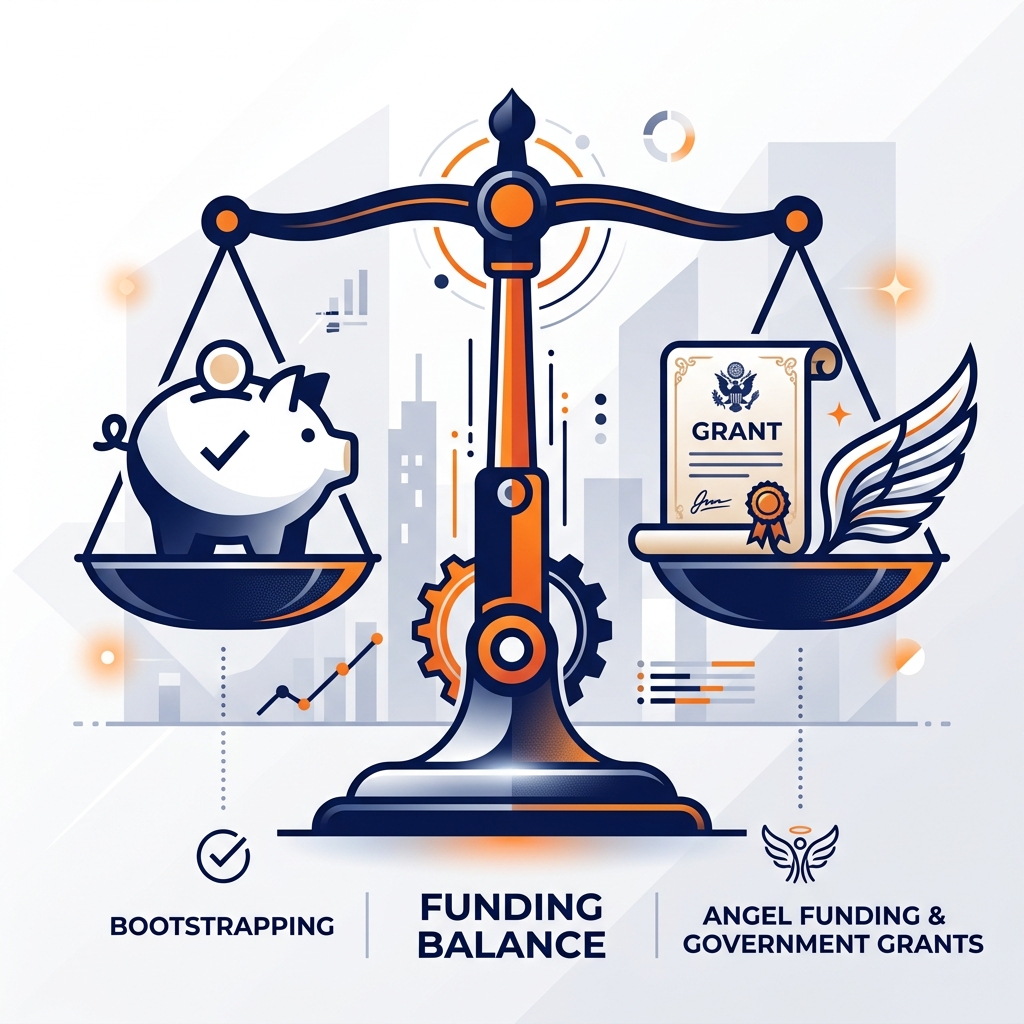
This guide is not about declaring a winner. Bootstrapping, angel funding, and government grants are not competing options — they are complementary instruments. The question is not 'which one is best?' but 'which one is right for me, right now, given where my startup is and where I want it to go?'
By the end of this guide, you will have a clear, practical framework for making that decision — and knowing when and how to combine all three.
Why the Funding Path You Choose Shapes Everything
The way you fund your startup in its early stages does not just determine how much money you have. It determines:
- How much of your company you own when you eventually raise a serious round — or exit
- What pressure and expectations you operate under on a day-to-day basis
- How fast you are forced to grow — even if the product is not ready
- Who has a say in your strategic decisions
- Whether you qualify for follow-on funding sources that require a clean cap table
A founder who bootstraps to ₹1 crore ARR before raising angel funding will almost always raise at a higher valuation, with better terms, and from a position of strength. A founder who raises angel money at the idea stage gives away a significant chunk of equity before they know whether the business will work.
Neither path is inherently wrong. The timing, the amount, and the sequence make all the difference.
<w:bottom w:val="single" w:color="1A6E3C" w:sz="12" w:space="4"/><w:left w:val="single" w:color="1A6E3C" w:sz="40" w:space="8"/><w:right w:val="single" w:color="1A6E3C" w:sz="12" w:space="4"/></w:pBdr><w:spacing w:before="200" w:after="180"/><w:ind w:left="360"/></w:pPr><w:r><w:rPr><w:rFonts w:ascii="Arial" w:cs="Arial" w:eastAsia="Arial" w:hAnsi="Arial"/><w:b/><w:bCs/><w:color w:val="1A6E3C"/><w:sz w:val="28"/><w:szCs w:val="28"/></w:rPr><w:t xml:space="preserve">💼 Path 1: Bootstrapping — Build on your own terms — but know its limits
What Is Bootstrapping?
Bootstrapping means funding your startup entirely from your own resources — personal savings, revenue generated by the business itself, or income from part-time or freelance work alongside building the startup. There is no external capital, no investors, and no loan obligations.
In India, bootstrapping has produced some of the country's most celebrated companies. Zoho, Zerodha, and Wingify all bootstrapped to significant scale before (or without) ever raising external capital. For the right type of business with the right type of founder, it remains one of the most powerful paths available.
The Real Advantages of Bootstrapping
- Complete ownership: You own 100% of your company — every rupee of value you create belongs entirely to you
- Full control: No investor board seats, no quarterly reporting obligations, no pressure to prioritise growth over sustainability
- Disciplined decision-making: When capital is scarce, you focus ruthlessly on what actually matters — revenue and customers
- No dilution penalty: When you eventually raise funding (if you choose to), you negotiate from a position of demonstrated traction, not just a pitch
- Faster product-market fit discovery: Revenue pressure forces you to sell early — which often reveals product-market fit faster than funded startups that can afford to 'build more first'
- Cultural independence: No external pressure to hire fast, spend on marketing, or pivot to please investors
The Real Limitations of Bootstrapping
- Speed constraint: Without capital, you grow at the speed of your own revenue — which may be too slow in winner-take-all markets
- Opportunity cost: Founders often sacrifice salary for years, creating personal financial strain that affects decision-making
- Competitive disadvantage: In markets where competitors are VC-funded and spending aggressively on growth, a bootstrapped company may struggle to keep pace
- Talent limitation: Without capital, you cannot easily hire senior talent who expect market salaries
- Scalability ceiling: Some business models — especially those with high upfront infrastructure or R&D costs — simply cannot bootstrap their way to viability
When Bootstrapping Is the Right Choice
- Your business generates revenue quickly — services, consulting, B2B products with short sales cycles
- Your market is not winner-take-all and does not require massive early spend to establish position
- You have personal savings that can sustain 12–24 months of operation without salary
- You want to maintain full control and are willing to accept slower growth in exchange
- Your business model has positive unit economics from day one or very early on
💡 The Bootstrapping Trap: Many founders bootstrap for so long that they miss the optimal fundraising window. A business that is too established and too profitable to need early-stage funding — but not yet at the scale to attract growth PE — often finds itself in a funding no-man's-land. Bootstrapping is a strategy, not just a default.
<w:bottom w:val="single" w:color="6B2FA0" w:sz="12" w:space="4"/><w:left w:val="single" w:color="6B2FA0" w:sz="40" w:space="8"/><w:right w:val="single" w:color="6B2FA0" w:sz="12" w:space="4"/></w:pBdr><w:spacing w:before="200" w:after="180"/><w:ind w:left="360"/></w:pPr><w:r><w:rPr><w:rFonts w:ascii="Arial" w:cs="Arial" w:eastAsia="Arial" w:hAnsi="Arial"/><w:b/><w:bCs/><w:color w:val="6B2FA0"/><w:sz w:val="28"/><w:szCs w:val="28"/></w:rPr><w:t xml:space="preserve">👼 Path 2: Angel Funding — Smart money and a network — at the cost of equity
What Is Angel Funding?
Angel funding comes from High Net Worth Individuals (HNIs) who invest their personal capital into early-stage startups in exchange for equity. Angels are typically successful entrepreneurs, senior executives, or professionals who want to back the next generation of founders — often in sectors they know well.
In India's startup ecosystem, angel investment has grown dramatically over the past decade. Platforms like LetsVenture, AngelList India, Indian Angel Network (IAN), and Mumbai Angels have systematised what was once a purely relationship-driven activity — making it more accessible to founders outside the traditional IIT/IIM network.
What Angels Actually Offer Beyond Money
- Domain expertise: Angels who have built businesses in your sector can provide operational insights that no amount of capital can buy
- Network access: A well-connected angel can open doors to customers, partners, and follow-on investors that would take years to build independently
- Credibility signal: A named angel investor on your cap table signals to future investors that a credible person has already validated your startup
- Mentoring and accountability: Many angels take an active interest in the startups they back — regular conversations with someone who has 'been there' is underrated
- Bridge to institutional capital: Angels who are known to VC funds can meaningfully accelerate your Series A or seed institutional round
The Real Cost of Angel Funding
- Equity dilution: A typical angel round in India involves giving up 10–25% equity — at the earliest stage, when your company is worth the least
- Valuation pressure: Negotiating a fair valuation at the idea or early-MVP stage is genuinely difficult — you are negotiating without much leverage
- Angel tax risk: Without DPIIT recognition, investments above fair market value can be taxed under Section 56(2)(viib) — this is eliminated with DPIIT registration
- Cap table complexity: Multiple angels on the cap table without proper documentation and shareholder agreements can create serious governance problems later
- Expectation misalignment: Some angels invest expecting fast exits or aggressive growth timelines that may not suit your business model
How to Find the Right Angel Investors in India
- LetsVenture: India's largest startup-investor matchmaking platform — create a profile and apply to listed syndicates
- AngelList India: Good for tech founders; connects to both domestic and international angel investors
- Indian Angel Network (IAN): One of India's oldest and most active angel networks — strong in B2B tech, healthcare, and consumer
- Sector-specific angels: Founders who have exited successful startups in your sector are often the most valuable angels — seek them specifically
- Accelerator networks: Y Combinator, 500 Startups India, Sequoia Surge, and T-Hub alumni networks often include active angel investors
- ConsultUp India's investor network: Our 250+ investor connections include curated angel investors across sectors — introduced based on stage and domain fit
When Angel Funding Is the Right Choice
- You have a validated MVP or strong POC with early user evidence
- The capital will be used for a specific, measurable milestone — not general expenses
- You have identified angels with genuine domain expertise in your sector, not just money
- Your business model requires more capital than bootstrapping can provide but is too early for institutional VCs
- You are ready to exchange equity for speed, network, and credibility — and have thought carefully about the valuation
⚠️ Angel Funding Warning: The most common mistake in angel fundraising is accepting the first offer from the first interested investor. Angel investors negotiate hard on valuations and terms. If you do not have a competing term sheet or a clear valuation anchor, you are negotiating blind. Always get multiple conversations going simultaneously — and always have your DPIIT recognition in place before the first investor conversation.
<w:bottom w:val="single" w:color="1A3C6E" w:sz="12" w:space="4"/><w:left w:val="single" w:color="1A3C6E" w:sz="40" w:space="8"/><w:right w:val="single" w:color="1A3C6E" w:sz="12" w:space="4"/></w:pBdr><w:spacing w:before="200" w:after="180"/><w:ind w:left="360"/></w:pPr><w:r><w:rPr><w:rFonts w:ascii="Arial" w:cs="Arial" w:eastAsia="Arial" w:hAnsi="Arial"/><w:b/><w:bCs/><w:color w:val="1A3C6E"/><w:sz w:val="28"/><w:szCs w:val="28"/></w:rPr><w:t xml:space="preserve">🏛️ Path 3: Government Grants — Free money — if you know how to ask for it correctly
What Are Government Grants for Startups?
Government grants are non-repayable funds provided by central or state government bodies to startups that meet specific eligibility criteria — usually around innovation, sector focus, employment generation, or social impact. Unlike loans, grants do not need to be repaid. Unlike equity, they do not dilute your ownership.
India's grant ecosystem for startups is one of the most extensive in Asia — covering schemes from the Startup India Seed Fund (SISFS) and Atal Innovation Mission to TIDE 2.0, state-level incubation grants, and sector-specific programs from ministries like MeitY, DST, DBT, and the Ministry of MSME.
The Real Advantages of Government Grants
- Zero dilution: You keep 100% of your equity — no shares, no board seats, no governance obligations
- Zero repayment: Unlike loans, grants are not repaid if the conditions are met — this is genuinely free capital
- Credibility signal: A government grant is a powerful third-party endorsement — it validates your innovation to future private investors
- Stage accessibility: Many grants are specifically designed for idea-stage and POC-stage startups that private investors would never fund
- Stackability: You can receive multiple grants simultaneously — central, state, and sector-specific — significantly amplifying total capital raised
- Non-cash benefits: Many grant programs include free infrastructure, mentoring, IP support, and networking that have significant indirect value
The Real Challenges of Government Grants
- Documentation intensity: Grant applications require detailed Detailed Project Reports, financial projections, and compliance documentation — a poorly prepared application is almost always rejected
- Long timelines: From application to disbursement, government grants can take 3–9 months — this is not capital you can rely on for immediate operational needs
- Eligibility complexity: Each scheme has specific eligibility criteria — sector focus, founder profile, entity age, annual turnover — and mismatches lead to wasted effort
- Competitive evaluation: Popular schemes like SISFS receive thousands of applications — strong documentation is not just helpful, it is necessary
- Conditions and reporting: Many grants come with milestone reporting, auditing requirements, and use-of-funds restrictions that require compliance discipline
The Grant Ecosystem Most Founders Miss
Most founders know about one or two central government schemes and assume that is the full picture. In reality, the grant ecosystem is far deeper:
- Central government schemes: SISFS, AIM, TIDE 2.0, NIF, DST grants, DBT BIRAC (biotech), MEITY schemes — most founders know 2 out of 15+ available
- State government grants: Gujarat (SSIP, iCreate), Karnataka (KBITS), Telangana (T-Hub), Maharashtra (MahaStartup), Rajasthan — each with distinct programs and funding pools
- Incubator-specific grants: IIT, IIM, and government-backed incubators distribute their own grant pools to selected startups — accessible through incubation program applications
- Ministry-specific grants: Healthcare (BIRAC), agriculture (RKVY-RAFTAAR), defence (iDEX), education (AICTE) — sector-specific programs with dedicated annual budgets
The average well-prepared startup in India can access 4–6 applicable grant programs across central, state, and sector levels. Most apply to 1.
When Government Grants Are the Right Choice
- You are at the idea, POC, or MVP stage and need non-dilutive capital to validate your concept
- Your startup has a clear innovation angle, social impact element, or sector focus that aligns with scheme priorities
- You have or can quickly obtain DPIIT recognition — the gateway to most central schemes
- You can invest the time in quality documentation — or work with an advisor who can
- You want to build a funding base before approaching private investors — grants improve your valuation anchor and reduce the pressure to accept unfavourable angel terms
💡 ConsultUp Insight: At ConsultUp India, the most common thing we tell founders is this: before you pitch your first angel investor, exhaust every applicable government grant. Non-dilutive capital at the idea and POC stage is almost always available if you know where to look and how to apply. Every rupee you raise in grants is a rupee of equity you do not have to sell — often at the worst possible valuation.
The Head-to-Head Scorecard: Bootstrapping vs Angel Funding vs Government Grants
Factor
Bootstrapping
Angel Funding
Government Grants
Equity dilution
None
10–25% per round
None
Repayment required
N/A
No (equity, not debt)
No
Speed to funds
Immediate
2–6 months
3–9 months
Documentation needed
Minimal
Pitch deck + financials
DPR + deck + projections
Control retained
100%
Diluted, board pressure
100% (conditions apply)
Typical amount
₹0 – ₹25 Lakh
₹10 L – ₹3 Crore
₹5 L – ₹1.5 Crore
Best stage
All stages
MVP to early traction
Idea, POC, MVP
Network / mentoring
None
High (if right angel)
Moderate (incubator)
Credibility signal
Low
High
High
Scalability limit
Revenue-constrained
None (investor-backed)
Fixed disbursement cap
Can be combined
Yes — base layer
Yes — on top of grants
Yes — before angel round
Risk if failed
Personal capital loss
Reputational + equity gone
No financial loss
The Decision Framework: Which Path Is Right for You Right Now?
Use these four questions to navigate your decision:
Question 1: How urgently do you need capital?
If immediate (days/weeks): Bootstrap. Government grants take months. Angel rounds take months. Your own capital is the only thing that moves at startup speed.
If soon (1–3 months): Start the government grant process now while simultaneously building your investor documentation. Both take time — start both early.
If planning ahead (3–6 months): Build a proper grant-first strategy. Identify applicable schemes, prepare documentation, and submit applications before you approach angel investors.
Question 2: How much equity are you willing to give up?
None: Bootstrapping and government grants are your only options. Determine which is more feasible given your runway.
10–20% (carefully): Pursue government grants first to build capital and credibility, then approach angels from a position of traction rather than pure pitch.
Comfortable with dilution for the right partner: Angel funding may be appropriate — but only if the angel brings meaningful domain expertise or network access, not just capital.
Question 3: Do you have a validated product or just an idea?
Just an idea: Government grants (SISFS, AIM, incubators) are your best option. Angel investors rarely fund ideas without any validation.
Working POC or prototype: Both government grants (SISFS POC tranche) and early angel conversations become viable. Start grant applications immediately; build investor collateral in parallel.
MVP with users or revenue: You now have leverage. Approach angel investors with your traction story. Continue applying for applicable government schemes in parallel — they remain accessible.
Question 4: What does your market dynamics require?
Slow, steady market — winner is not determined by spending: Bootstrapping to profitability is a legitimate strategy. Capital efficiency is a competitive advantage.
Competitive market where speed matters: You need external capital to keep pace. Government grants for the non-dilutive base, angels for the growth acceleration layer.
Winner-take-all market — need to move fast: Angel and institutional funding is necessary. But still do the grant applications — non-dilutive capital in a competitive market is doubly valuable because it extends your runway without giving up equity at the worst time.
The Smart Stack: Why the Best Founders Use All Three
The founders who build the most capital-efficient, high-value startups in India rarely choose just one path. They stack all three — in the right sequence, at the right time.
Here is the funding stack that ConsultUp India guides our clients to build:
Phase 1: Non-Dilutive Foundation (Months 0–6)
Start with bootstrapping for basic incorporation, DPIIT registration, and initial validation. Simultaneously apply for applicable government grants — SISFS, AIM, state-level incubation, sector-specific programs. Target ₹15–50 lakh in grants before approaching any private investor.
Goal: Build your first capital base without giving up any equity. Use grants to fund POC validation and early product development.
Phase 2: Credibility-Backed Angel Round (Months 6–18)
Approach angel investors with your DPIIT recognition certificate, your grant award letters, your working POC or MVP, and early user data. Your valuation anchor is now backed by third-party validation from the government — not just your own optimism. You negotiate from strength, not desperation.
Goal: Raise an angel round at a meaningfully higher valuation than would have been possible at the idea stage — because you have real proof points and non-dilutive capital already deployed.
Phase 3: Institutional Capital with Traction (Month 18+)
With angel backing, demonstrated traction, and a track record of managing both private and government capital responsibly, you are now positioned to approach seed-stage VCs and institutional investors. Your cap table is clean, your documentation is institutional-grade, and your story has multiple independent validation points.
Goal: Enter institutional fundraising as a credible, capital-efficient founder with a demonstrated ability to extract maximum value from every rupee — a trait sophisticated investors specifically look for.
5 Mistakes Founders Make When Choosing a Funding Path
Mistake 1: Treating the Three Paths as Mutually Exclusive
Bootstrapping, angel funding, and government grants are not either/or choices. They are most powerful when combined intelligently. The founder who bootstraps + grants before approaching angels almost always gets better angel terms than the one who goes to angels first.
Mistake 2: Taking Angel Money Too Early at Too Low a Valuation
Accepting a ₹10 lakh angel investment at a ₹40 lakh post-money valuation means giving up 25% of your company before your product exists. That dilution is almost impossible to recover from. Wait until you have validation — even if it means bootstrapping a few more months.
Mistake 3: Applying for Grants Too Late
Many founders apply for government grants after they have already raised an angel round and built traction. While grants remain accessible at later stages, the maximum benefit comes at the idea and POC stage — where every rupee of grant replaces equity you would otherwise have to sell. Start grant applications on day one, not as an afterthought.
Mistake 4: Bootstrapping Past the Optimal Fundraising Window
Bootstrapping discipline is a virtue — until it becomes stubbornness. Founders who refuse to raise external capital even when their business is growing and the market is moving fast often discover that they missed the window where their startup had the most fundraising momentum. Bootstrapping is a strategy, not an ideology.
Mistake 5: Ignoring the Downstream Impact on Cap Table
Every early equity decision compounds. A 5% angel cheque at seed stage might feel small — but after a seed round, Series A, and Series B, that 5% may have diluted to 1.5%. Conversely, keeping equity clean in the early stages by maximising grant funding means the founder retains meaningful ownership through multiple rounds. Model your cap table before every equity decision, not after.
How ConsultUp India Helps You Build the Right Funding Mix
At ConsultUp India, we do not believe in a one-size-fits-all funding strategy. Every startup is different — different stage, different sector, different founder profile, different market dynamics. Our job is to help you identify the right mix of bootstrapping discipline, government grant maximisation, and angel investor access for your specific situation.
Our services span all three funding paths:
- Government grants: Scheme mapping, DPIIT recognition, grant-ready pitch decks, Detailed Project Reports (DPRs), financial projections, and application management for up to 15 schemes
- Angel and investor access: Curated introductions to our 250+ investor network, investor-grade pitch deck and financial model preparation, mock pitch and Q&A sessions
- Funding strategy advisory: Stage-specific funding roadmaps that sequence bootstrapping, grants, and equity in the right order for your business
- Documentation preparation: Every document you need across all three paths — pitch deck, financial projections, DPR, executive summary, investor collateral — built to institutional standards
<w:bottom w:val="single" w:color="1A3C6E" w:sz="6" w:space="4"/><w:left w:val="single" w:color="1A3C6E" w:sz="6" w:space="4"/><w:right w:val="single" w:color="1A3C6E" w:sz="6" w:space="4"/></w:pBdr><w:spacing w:before="160" w:after="160"/><w:jc w:val="center"/></w:pPr><w:r><w:rPr><w:rFonts w:ascii="Arial" w:cs="Arial" w:eastAsia="Arial" w:hAnsi="Arial"/><w:b/><w:bCs/><w:sz w:val="22"/><w:szCs w:val="22"/></w:rPr><w:t xml:space="preserve">🎯 Not sure which funding path fits your startup? Visit consultupindia.com or call 1800-202-1945 for a free funding strategy consultation.
Final Thoughts
There is no universally correct answer to the bootstrapping vs angel funding vs government grants debate. The right answer depends entirely on your startup's stage, your market dynamics, your personal financial situation, and what you want your company to look like in 5 years.
What is universally true is this: the founders who raise the best capital, on the best terms, at the right time, are the ones who have thought carefully about these trade-offs — and made deliberate, strategic decisions rather than reactive ones.
Start with what you know: Where are you today? What do you need in the next 6 months? What are you willing to give up — and what are you not? Build your funding strategy from those answers, not from what everyone else in your peer group is doing.
And if you need help thinking it through, ConsultUp India is here to do exactly that.
Tags: bootstrapping vs angel funding India, government grants vs investor funding, startup funding path India, angel investor India 2026, SISFS vs angel funding, how to fund a startup India, equity dilution startup India, ConsultUp India funding strategy
© 2026 ConsultUp India (CISPL Conzultupindia Services Private Limited) | consultupindia.com
Ready to become funding-ready?
Book a free consultation and we’ll map your funding roadmap — grants, investors, and compliance in one plan.
Book a call# Keep reading

Idea Stage to Early Traction: What Kind of Funding Should Your Startup Raise at Each Stage?
One of the most common — and most costly — mistakes early-stage founders make is chasing the wrong kind of funding at the wrong stage.