
Idea Stage to Early Traction: What Kind of Funding Should Your Startup Raise at Each Stage?
Introduction
One of the most common — and most costly — mistakes early-stage founders make is chasing the wrong kind of funding at the wrong stage.
A founder at the idea stage cold-emailing Series A VCs. A POC-stage startup applying for growth-stage private equity. An MVP-stage company ignoring ₹25 lakh in available government grants because they are too focused on finding angel investors.
The type of funding you should be raising is not fixed — it changes at every stage of your startup journey. And understanding this is the difference between spending six months banging on the wrong doors and closing your first cheque in sixty days.
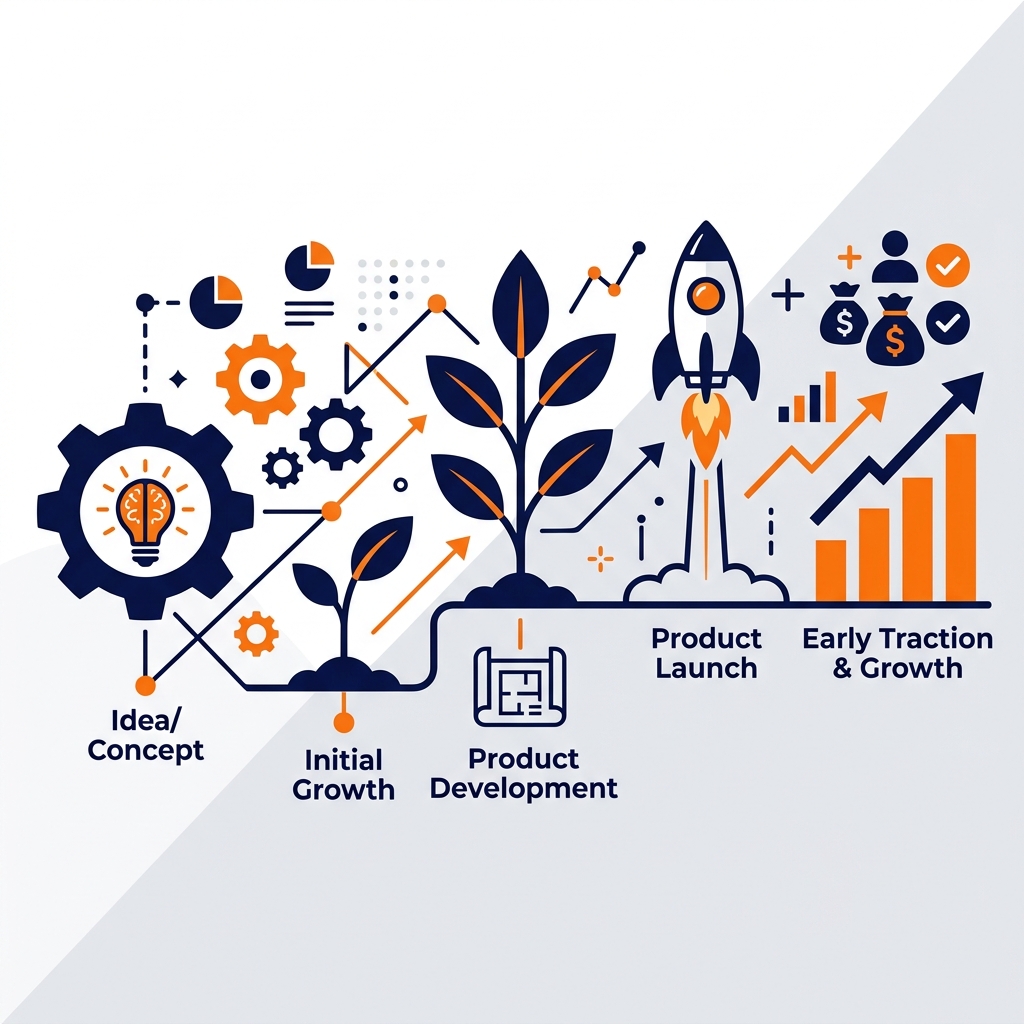
In this guide, we map out five key startup stages — Idea, Proof of Concept (POC), MVP, Early Traction, and SME/Growth — and break down exactly what kind of funding is most accessible, most appropriate, and most strategically valuable at each one. We also cover the biggest mistakes founders make at each stage and what investors and grant bodies are actually looking for.
Why Startup Stage Determines Your Funding Strategy
Every source of capital — whether it is a government grant, an angel investor, a VC fund, or a bank loan — has a specific risk appetite. That risk appetite is almost entirely defined by what stage of validation your startup has achieved.
Consider it from the capital provider's perspective:
- A government grant committee wants to fund innovation with social or economic impact — not proven revenue machines
- An angel investor is betting on a founder and an idea — they accept high risk in exchange for early entry valuation
- A VC fund needs a proven business model and early traction before investing — they are optimising for scale, not discovery
- A bank or NBFC needs demonstrated repayment capacity — they are not risk investors at all
Raising the right type of capital at the right stage means your ask aligns with the risk appetite of the capital provider. Misalignment wastes everyone's time — most importantly yours.
Quick Reference: Funding by Stage
Stage
Best Funding Sources
Typical Ticket Size
What You Need
Idea Stage
Bootstrapping, F&F, Govt. Grants
₹0 – ₹25 Lakh
Concept + DPIIT recognition
POC Stage
Govt. Grants, Incubators, Angels
₹10 – ₹50 Lakh
Validated concept + DPR/deck
MVP Stage
Angels, Incubators, Seed Funds, Grants
₹25 L – ₹1.5 Cr
Working product + early users
Early Traction
Angel Rounds, Seed VCs, Revenue-based
₹50 L – ₹5 Cr
Revenue / MoM growth + deck
SME / Growth
PE/VC, Debt, SIDBI, Revenue-based Finance
₹2 Cr – ₹50 Cr+
Strong financials + scale plan
<w:bottom w:val="single" w:color="1A3C6E" w:sz="12" w:space="4"/><w:left w:val="single" w:color="1A3C6E" w:sz="36" w:space="8"/><w:right w:val="single" w:color="1A3C6E" w:sz="12" w:space="4"/></w:pBdr><w:shd w:fill="F8F9FF" w:val="clear"/><w:spacing w:before="200" w:after="160"/><w:ind w:left="360"/></w:pPr><w:r><w:rPr><w:rFonts w:ascii="Arial" w:cs="Arial" w:eastAsia="Arial" w:hAnsi="Arial"/><w:b/><w:bCs/><w:color w:val="1A3C6E"/><w:sz w:val="26"/><w:szCs w:val="26"/></w:rPr><w:t xml:space="preserve">💡 Stage 1: Idea Stage — You have the vision. Now prove it is worth funding.
Where You Are
You have identified a problem and have a hypothesis for how to solve it. You may have done some market research, spoken to potential customers, or sketched out a business model. But you have no product, no revenue, and no validated proof that anyone will pay for what you are building.
This is the stage where most founders feel stuck — because traditional investors almost never fund at this point, and many founders do not know what alternatives exist.
The Right Funding Sources at Idea Stage
- Bootstrapping: Your own savings, part-time income, or freelance work to fund initial validation activities
- Friends and Family (F&F): Informal capital from personal network — typically ₹1–10 lakh, useful for basic incorporation and early experiments
- Government Grants — DPIIT + SISFS: Once incorporated and DPIIT-recognised, you become eligible for the Startup India Seed Fund Scheme (up to ₹20 lakh for proof of concept validation)
- Incubation Programs: IIT, IIM, NSRCEL, AIC, and state-government-backed incubators offer equity-free grants, infrastructure, and mentoring to idea-stage startups
- Student Startup Grants: NIF and DST programs for student innovators — grants up to ₹10 lakh with no equity requirement
- Startup competitions and hackathons: Prize money and visibility — not transformative capital, but useful for credibility and early network
What Capital Providers Look for at This Stage
- A clearly defined, real problem — not a solution looking for a problem
- Evidence of founder-market fit: Why are you the right person to solve this?
- Basic market sizing: Is this a large enough opportunity to justify investment?
- A coherent vision for how the solution will work — even if unbuilt
- For government grants: social or economic impact potential, employment creation, innovation angle
The Biggest Mistake at Idea Stage
Pitching to VCs or angel investors before having any validation. This burns credibility, wastes time, and creates a permanent record of rejection with investors who would otherwise consider you at a later stage. The idea stage is for government grants, incubators, and bootstrapping — not private equity.
💡 ConsultUp Insight: At the idea stage, the single most impactful thing you can do is get DPIIT recognition and apply to the Startup India Seed Fund Scheme. This combination can unlock ₹20–50 lakh in equity-free capital — enough to build a POC and dramatically improve your position for the next funding stage.
<w:bottom w:val="single" w:color="6B2FA0" w:sz="12" w:space="4"/><w:left w:val="single" w:color="6B2FA0" w:sz="36" w:space="8"/><w:right w:val="single" w:color="6B2FA0" w:sz="12" w:space="4"/></w:pBdr><w:shd w:fill="F8F9FF" w:val="clear"/><w:spacing w:before="200" w:after="160"/><w:ind w:left="360"/></w:pPr><w:r><w:rPr><w:rFonts w:ascii="Arial" w:cs="Arial" w:eastAsia="Arial" w:hAnsi="Arial"/><w:b/><w:bCs/><w:color w:val="6B2FA0"/><w:sz w:val="26"/><w:szCs w:val="26"/></w:rPr><w:t xml:space="preserve">🔬 Stage 2: POC Stage — You have tested the concept. Now prove the solution works.
Where You Are
You have moved beyond the idea and demonstrated — through a basic prototype, pilot, or experiment — that your proposed solution is technically feasible and that there is genuine user interest. You may have a rough working model, a landing page with signups, or letters of intent from potential customers.
This is the stage where government funding is still very accessible, and the first angel investors start paying attention — especially if you can demonstrate founder credibility alongside the POC.
The Right Funding Sources at POC Stage
- Government Grants — SISFS (POC tranche): Up to ₹20 lakh specifically for prototype development and proof of concept — this is what the first tranche of SISFS is designed for
- Atal Innovation Mission (AIM) / ANIC: Grants up to ₹1 crore for startups solving national-priority problems with a working POC
- TIDE 2.0 (MeitY): For ICT and tech startups with a validated concept — up to ₹1.5 crore through MeitY-supported incubators
- Incubators and Accelerators: Equity-free or equity-light programs from T-Hub, NSRCEL, CIIE, and 500+ other programs across India
- Angel Investors: First angel conversations begin here — typically ₹10–50 lakh from individuals who back the founder and the concept
- PMEGP / CGTMSE: If your startup involves physical product manufacturing or services, these schemes are now accessible with a basic business plan
What Capital Providers Look for at POC Stage
- A working prototype or pilot result — even if rough and imperfect
- Early customer conversations: Have you spoken to 20–50 potential customers? What did they say?
- Clear articulation of the problem, solution, and differentiation
- Founder background: Why does this team have the credibility to solve this problem?
- Basic financial projections — even if estimates, they demonstrate business thinking
The Biggest Mistake at POC Stage
Raising too much too early and over-diluting. A founder who raises ₹50 lakh at a ₹50 lakh post-money valuation has given away 50% of the company before having a single paying customer. At POC stage, prioritise non-dilutive government grants over equity. Raise equity sparingly and at realistic valuations.
💡 ConsultUp Insight: POC-stage startups often underestimate how much non-dilutive capital is available to them. Between SISFS, AIM, TIDE 2.0, state incubation grants, and one or two angel investors, a well-prepared POC-stage startup can build a ₹25–75 lakh funding base without giving up significant equity. The documentation quality — pitch deck, projections, and application — is what separates funded from unfunded at this stage.
<w:bottom w:val="single" w:color="0D6E6E" w:sz="12" w:space="4"/><w:left w:val="single" w:color="0D6E6E" w:sz="36" w:space="8"/><w:right w:val="single" w:color="0D6E6E" w:sz="12" w:space="4"/></w:pBdr><w:shd w:fill="F8F9FF" w:val="clear"/><w:spacing w:before="200" w:after="160"/><w:ind w:left="360"/></w:pPr><w:r><w:rPr><w:rFonts w:ascii="Arial" w:cs="Arial" w:eastAsia="Arial" w:hAnsi="Arial"/><w:b/><w:bCs/><w:color w:val="0D6E6E"/><w:sz w:val="26"/><w:szCs w:val="26"/></w:rPr><w:t xml:space="preserve">🛠️ Stage 3: MVP Stage — Your product works. Now find the people who need it.
Where You Are
You have built a Minimum Viable Product — a functional version of your solution that real users can interact with. You may have your first 10–100 users, beta testers, or paying customers. You understand what works, what does not, and what the product needs to become.
This is the stage where angel investors become genuinely interested and where the first institutional seed funds start evaluating you. Government grants are still accessible, especially for tech-focused or impact-driven MVPs.
The Right Funding Sources at MVP Stage
- Angel investors and angel networks: HNIs, angel platforms like LetsVenture, AngelList India, and Indian Angel Network — ticket sizes of ₹25 lakh to ₹1.5 crore
- Seed funds: Early-stage VC funds focused on pre-revenue or early-revenue startups — Blume Ventures, Stellaris, 100X.VC, Turbostart — typical cheques of ₹50 lakh to ₹2 crore
- SISFS commercialisation tranche: Up to ₹50 lakh soft loan for early market entry — specifically for startups that have completed the POC tranche
- Revenue-based financing (RBF): For startups with any recurring revenue — platforms like Velocity, GetVantage, and N+1 Capital offer non-dilutive capital against future revenue
- Convertible notes and SAFE instruments: Flexible equity instruments used by angel investors to bridge the valuation question — popular in the Indian ecosystem post-2022
- State government incubation grants: ₹10–50 lakh from state startup missions for MVPs demonstrating local economic impact
What Capital Providers Look for at MVP Stage
- A functional product — not just a mockup or wireframe
- User feedback: NPS scores, retention data, qualitative testimonials
- Early revenue or strong pre-revenue indicators: LOIs, paid pilots, waitlist conversion
- Product-market fit hypothesis: Can you explain specifically who your ideal customer is and why they choose you over alternatives?
- A founding team with complementary skills — tech + business is the most common successful combination
- Clear use of funds: What exactly will this capital help you achieve in the next 12–18 months?
The Biggest Mistake at MVP Stage
Raising a large round before finding product-market fit. An MVP that has not yet found its ideal customer segment is not ready for a ₹3–5 crore seed round. Over-raising at this stage leads to pressure to scale prematurely — often before the product is ready. Raise enough to find PMF, not to scale before you have found it.
💡 ConsultUp Insight: At MVP stage, the pitch deck and financial model matter more than at any previous stage — because this is where investors start doing real due diligence. We regularly help MVP-stage startups reframe their narrative, rebuild their financial projections from scratch, and prepare for investor Q&A — the combination that converts initial interest into signed term sheets.
<w:bottom w:val="single" w:color="1A6E3C" w:sz="12" w:space="4"/><w:left w:val="single" w:color="1A6E3C" w:sz="36" w:space="8"/><w:right w:val="single" w:color="1A6E3C" w:sz="12" w:space="4"/></w:pBdr><w:shd w:fill="F8F9FF" w:val="clear"/><w:spacing w:before="200" w:after="160"/><w:ind w:left="360"/></w:pPr><w:r><w:rPr><w:rFonts w:ascii="Arial" w:cs="Arial" w:eastAsia="Arial" w:hAnsi="Arial"/><w:b/><w:bCs/><w:color w:val="1A6E3C"/><w:sz w:val="26"/><w:szCs w:val="26"/></w:rPr><w:t xml:space="preserve">📈 Stage 4: Early Traction Stage — You have proof. Now it is time to raise real money.
Where You Are
Your startup has moved beyond guessing. You have paying customers, measurable revenue, and Month-on-Month growth that you can demonstrate to investors. You understand your unit economics — CAC, LTV, churn, and gross margin — even if they are not yet optimised. This is the stage where private capital becomes genuinely competitive to access.
The Right Funding Sources at Early Traction Stage
- Seed and Pre-Series A VC funds: The primary institutional capital source at this stage — Indian VCs like Sequoia Surge, Accel, Nexus, and Elevation Capital regularly write ₹1–10 crore cheques at early traction stage
- Angel rounds and syndicates: Organised angel syndicates — often led by a lead investor with a track record — bring ₹50 lakh to ₹3 crore in structured rounds
- Private Equity (sector-specific): Niche PE funds focused on healthcare, agri-tech, fintech, or edtech often invest at early traction stage in high-potential opportunities
- SIDBI Fund of Funds: If you are fundraising from SEBI-registered VCs, check whether the fund has received SIDBI FFS allocation — it often accelerates commitment timelines
- Revenue-based financing: Significantly more accessible at this stage with demonstrable revenue — non-dilutive and fast to close
- Debt instruments: Venture debt from InnoVen Capital, Trifecta Capital, or Alteria Capital — supplement equity with non-dilutive debt to extend runway post-raise
What Capital Providers Look for at Early Traction Stage
- Revenue and growth rate: MRR, ARR, and Month-on-Month growth percentage — ideally 15–30% or higher for venture-scale opportunities
- Unit economics: CAC payback period under 12 months and LTV:CAC ratio of 3:1 or higher
- Retention: Weekly/monthly active users, churn rate, net revenue retention for SaaS models
- Market size validation: You have now proven the problem is real — can you credibly address a ₹1,000 Cr+ opportunity?
- Team and hiring plan: Do you have the team to execute at the next level of scale?
- Competitive moat: What makes your position defensible as you scale?
The Biggest Mistake at Early Traction Stage
Approaching investors without a data room and investor-grade documentation. At this stage, investors expect a complete pitch deck, detailed financial model with historical and projected data, cap table, and a clear use-of-funds plan. Coming to a VC meeting without this documentation — or with a poorly constructed version — signals that you are not ready to manage institutional capital responsibly.
💡 ConsultUp Insight: Early traction is where ConsultUp India's Incubation Pro+ and Accelerator packages deliver the most value. Founders at this stage need curated investor introductions, polished investor collateral, and mock pitch sessions that prepare them for the rigorous due diligence process of institutional investors. Our 250+ investor network becomes directly relevant here.
<w:bottom w:val="single" w:color="E8712A" w:sz="12" w:space="4"/><w:left w:val="single" w:color="E8712A" w:sz="36" w:space="8"/><w:right w:val="single" w:color="E8712A" w:sz="12" w:space="4"/></w:pBdr><w:shd w:fill="F8F9FF" w:val="clear"/><w:spacing w:before="200" w:after="160"/><w:ind w:left="360"/></w:pPr><w:r><w:rPr><w:rFonts w:ascii="Arial" w:cs="Arial" w:eastAsia="Arial" w:hAnsi="Arial"/><w:b/><w:bCs/><w:color w:val="E8712A"/><w:sz w:val="26"/><w:szCs w:val="26"/></w:rPr><w:t xml:space="preserve">🏢 Stage 5: SME / Growth Stage — You are operational and scaling. Capital fuels the engine.
Where You Are
Your business is established. You have consistent revenue, a defined team, operational processes, and potentially multi-year financials. You are not guessing about product-market fit — you are focused on geographic expansion, new product lines, operational efficiency, or market share consolidation.
At this stage, the funding options are the broadest — but so is the competition for capital. Investors and lenders at this level expect professional documentation, audited financials, and a clear growth thesis.
The Right Funding Sources at SME / Growth Stage
- Private Equity (Growth PE): Firms like ChrysCapital, Kedaara, Motilal Oswal PE, and hundreds of sector-specific PE funds write ₹5–100 crore+ tickets for profitable or near-profitable SMEs
- NBFC and bank term loans: With 2–3 years of financial statements, growth-stage SMEs can access structured term loans at competitive rates for capex, working capital, or expansion
- SIDBI direct lending: SIDBI's direct loan programs and SMILE scheme become very relevant — lower than market interest rates for expansion capital
- CGTMSE-backed credit lines: Even at growth stage, CGTMSE remains useful for working capital credit without pledging operating assets
- Venture debt: For post-Series A startups — InnoVen, Trifecta, and Alteria provide non-dilutive debt that extends runway between equity rounds
- Export credit and trade finance: ECGC, EXIM Bank, and commercial bank trade finance for SMEs with international revenue or ambitions
What Capital Providers Look for at SME / Growth Stage
- Audited financial statements for the last 2–3 years
- Positive or near-positive EBITDA — or a credible and short path to profitability
- Management team depth: Not just founders — department heads, CFO, COO
- Clear growth thesis: What does the raised capital specifically enable? New geographies, new products, M&A?
- Governance and compliance: Clean cap table, regular board meetings, proper statutory filings
- For PE: exit thesis — how does the investor realise returns in 4–7 years?
The Biggest Mistake at SME / Growth Stage
Poor financial governance. Many Indian SMEs have years of strong business operations but weak financial documentation — unreconciled books, missing filings, informal related-party transactions, or inconsistent GST records. These issues do not just reduce valuation — they can kill a deal entirely at the due diligence stage. Clean financials are not just an investor requirement; they are a business survival asset.
💡 ConsultUp Insight: Growth-stage SMEs are often surprised to discover they qualify for significant government-backed debt funding alongside private equity. A ₹20 crore PE raise can be meaningfully supplemented by ₹2–5 crore in SIDBI or CGTMSE-backed debt — reducing dilution and improving overall capital efficiency. We regularly help SMEs build hybrid capital structures that combine private equity, structured debt, and government schemes.
The Complete Funding Roadmap: Stage by Stage
Stage
Primary Sources
Avoid
Key Document
Idea
Govt grants, DPIIT, incubators, bootstrapping
VCs, PE, bank loans
DPIIT application, basic pitch deck
POC
SISFS, AIM, angels, TIDE 2.0, incubators
Growth PE, large debt
Grant-ready deck, DPR, projections
MVP
Angels, seed VCs, SISFS tranche 2, RBF
Series A VCs, heavy debt
Investor deck, financial model
Early Traction
Seed/Pre-A VCs, angel syndicates, SIDBI FFS
Govt grants (mostly closed)
Data room, growth metrics, cap table
SME/Growth
PE, SIDBI, CGTMSE, venture debt, bank loans
Friends & Family rounds
Audited financials, growth thesis
3 Cross-Stage Mistakes That Derail Every Funding Journey
Mistake 1: Skipping Government Grants in the Rush for Private Capital
Founders who land angel investment early often skip government grants entirely. This is a missed opportunity. Even post-seed, many government schemes remain accessible — especially state-level grants, CGTMSE-backed working capital loans, and SIDBI programs. Non-dilutive capital should always be layered in wherever possible, regardless of stage.
Mistake 2: No Documentation Readiness Between Rounds
The worst time to build your pitch deck and financial model is when an investor expresses interest. Most serious funding conversations happen fast — and founders who do not have investor-grade documentation ready lose deals to those who do. Maintain a live, updated investor deck and financial model at all times, regardless of whether you are actively fundraising.
Mistake 3: Raising at the Wrong Valuation
Under-valuing your startup to close a deal quickly, or over-valuing it to impress investors, both have serious downstream consequences. Under-valuation at seed stage means devastating dilution that damages your cap table for future rounds. Over-valuation creates a down-round risk that is extremely difficult to recover from. Get an independent view on valuation before every round — especially the first one.
How ConsultUp India Supports You at Every Stage
At ConsultUp India, we have designed our service packages specifically around these five startup stages — because we understand that the right support at each stage looks completely different.
Idea and POC Stage: Grant Starter and Pre-Incubation
Our Grant Starter (₹5,000) and Pre-Incubation (₹20,000) packages are built for founders at the idea and POC stage. They include DPIIT documentation support, a grant-ready pitch deck, financial projections, and applications to up to 5 relevant government schemes. The goal is to build your first ₹20–50 lakh in non-dilutive capital before approaching a single private investor.
MVP and Early Traction Stage: Incubation and Incubation Pro+
Our Incubation (₹30,000) and Incubation Pro+ (₹50,000) packages add investor-ready pitch decks, curated investor introductions, mock pitch sessions, and executive summary preparation to the government grant support. At this stage, you need both — and our packages ensure you are simultaneously maximising government funding and private investor access.
SME and Growth Stage: The Accelerator
Our Accelerator package (₹70,000) is designed for growth-stage founders ready to raise serious capital. It includes access to our full 250+ investor network, demo day and PR opportunities, advanced investor collateral, dedicated financial consultants, and structured debt advisory alongside government scheme applications. This is the full-service capital advisory engagement.
<w:bottom w:val="single" w:color="1A3C6E" w:sz="6" w:space="4"/><w:left w:val="single" w:color="1A3C6E" w:sz="6" w:space="4"/><w:right w:val="single" w:color="1A3C6E" w:sz="6" w:space="4"/></w:pBdr><w:spacing w:before="160" w:after="160"/><w:jc w:val="center"/></w:pPr><w:r><w:rPr><w:rFonts w:ascii="Arial" w:cs="Arial" w:eastAsia="Arial" w:hAnsi="Arial"/><w:b/><w:bCs/><w:sz w:val="22"/><w:szCs w:val="22"/></w:rPr><w:t xml:space="preserve">🚀 Not sure which stage you are at or what to raise? Visit consultupindia.com or call 1800-202-1945 for a free stage assessment and funding roadmap.
Final Thoughts
Your startup's funding journey is not a single event — it is a sequence of well-timed capital raises, each one building on the last. The founders who raise successfully at every stage are not the ones with the most connections or the most charisma. They are the ones who understand where they are, what each type of capital provider needs to see, and how to present themselves in the most credible, compelling way at exactly the right moment.
Whether you are sitting on a napkin sketch today or running a ₹5 crore ARR business, the right funding is out there. The question is whether you are approaching the right sources with the right story — at the right stage.
That is exactly what ConsultUp India is here to help you figure out.
Tags: startup funding stages India, idea stage funding India, POC funding startup, MVP investor India, early traction startup raise, angel investment India, seed fund India 2026, government grant startup stage, ConsultUp India funding advisory
© 2026 ConsultUp India (CISPL Conzultupindia Services Private Limited) | consultupindia.com
Ready to become funding-ready?
Book a free consultation and we’ll map your funding roadmap — grants, investors, and compliance in one plan.
Book a call# Keep reading
Bootstrapping vs Angel Funding vs Grants: What's the Right Funding Path for Indian Startups?
Every founder reaches a moment where the question is unavoidable: how do I fund this?